There’s a week every month when the money runs thin. You know the one. Payday is still a few days out, the fridge has odd little leftovers and not much else, and someone still needs to eat dinner tonight.
I used to dread that week. Now I mostly don’t, and the reason isn’t willpower or some clever coupon app. It’s that the cheapest food I know how to make is also the food my family likes, and I keep the makings of it on hand all the time. So the thin week isn’t a crisis. It’s just Tuesday.
This isn’t a lecture about how you should be eating rice and beans and feeling grateful. Feeding people on a tight budget is hard, and it’s harder now than it was a couple of years ago. Grocery prices at home rose 2.7% in the year to June 2026, and the USDA’s most bare-bones food plan for a family of four crossed $1,000 a month. You’re not imagining it, and you’re not doing it wrong.
What I want to give you is two things: a way of thinking that makes cheap weeks calm instead of scary, and a list of cheap family meals that genuinely feed four people for under $10. A lot of them come in under $6. Let’s start with the thinking, because it’s the part that keeps working after the recipe list is old news.
The one idea that changes everything: stock the pantry, not the recipe
Most meal advice tells you to plan a week of dinners, write the ingredients on a list, and go buy exactly those things. That sounds organized. It’s also the most expensive way to shop, because you’re buying whatever the recipe needs at whatever it costs that day.
A frugal writer named Amy Dacyczyn popularized the better way decades ago, and called it the pantry principle. (She was honest that she didn’t invent it either, she picked it up from an older book.) The idea flips the order around. You don’t decide what to eat and then buy it. You buy cheap, versatile staples when they hit a low price, keep them stocked, and then build meals from what you already have.
It’s a small change in wording and a huge change in your grocery bill. Shopping stops being “gather ingredients for Monday’s casserole” and becomes “restock the shelf.” When chicken is cheap this week, you buy extra chicken. When it’s not, you don’t make chicken, you make something from the beans and rice and pasta already in the cupboard. You almost never run out to the store for one thing, and you almost never pay full price.
You don’t build this pantry in one giant $300 trip. You add a little each week. Grab the second bag of rice when it’s cheap. Buy the dried beans when they’re on sale even if you already have some. Over a couple of months you end up with a shelf that means the thin week has options.
Meat is not the only protein (and this is where the money is)
Here’s the biggest lever, and it’s not a coupon. It’s rethinking what dinner is built around.
Most American dinners are designed around a hunk of meat, and meat is where the budget goes to die. In mid-2026 ground beef ran close to $6.83 a pound and boneless chicken breast around $4.17, and beef isn’t expected to get cheaper soon, the national cattle herd is the smallest it’s been in 75 years.
Now compare that to the cheap protein tier. Dried beans and lentils give you the most protein per dollar of almost anything in the store, somewhere around 20 grams of protein for a single dollar. Eggs are the cheapest animal protein there is. A pot of beans and a pot of rice, together, make a complete protein, the exact thing our bodies need, for pennies a serving. This is not hardship food. Half the world eats this way by choice, and it tastes great when you season it right.
So the shift is simple: make beans, eggs, and lentils the everyday base, and treat meat as a flavoring instead of the main event. A little sausage in a big pot of beans. A half pound of ground beef stretched across a whole tray of nachos built on beans. The meat is still there for taste. It’s just not carrying the whole meal on its back anymore.
The formula meal: how to cook without a recipe
Once your pantry is stocked and you’ve made peace with beans, you barely need recipes. You need a few templates that swallow whatever is cheap that week. Learn five of these and you’ll never stare into the fridge feeling stuck again.
The pot of beans. Dried beans, an onion, garlic, salt, whatever spice you like, and time. Eat them over rice, in a tortilla, mashed on toast, or thinned into soup. One cheap bag becomes four different dinners.
The grain bowl. A cooked grain on the bottom (rice, but any grain works), a protein (beans, a fried egg, leftover meat), a cooked vegetable, something fresh or crunchy on top, and a sauce to tie it together. Every part is swappable for whatever’s cheapest.
The stir-fry. Onion and garlic in a hot pan, then whatever protein you’ve got, then whatever vegetables are cheap or wilting, then a simple sauce, all over rice. This is the meal that empties your vegetable drawer.
The soup. An onion, a few vegetables, a starch (beans, rice, pasta, potato), water or homemade broth, and salt. Soup is the great forgiver. It doesn’t care that you only have half of everything.
The sheet-pan dinner. Chop a cheap protein and hardy vegetables, toss with oil and salt, roast on one tray until everything’s browned. Almost no dishes, almost no skill required.
Notice none of these tell you exactly what to buy. That’s the point. The template is fixed; the ingredients flex with the sale flyer. Amy Dacyczyn wrote out “universal” versions of casseroles and quiches for exactly this reason, a skeleton you hang cheap ingredients on.
30 cheap family meals that feed four for real
Prices below are rough, based on average US grocery prices in 2026, and your store will differ. I’m counting the cost to make the whole meal for four, not per person. Anything under $10 made the list; plenty come in far lower.
Built on beans and rice (the cheapest tier)
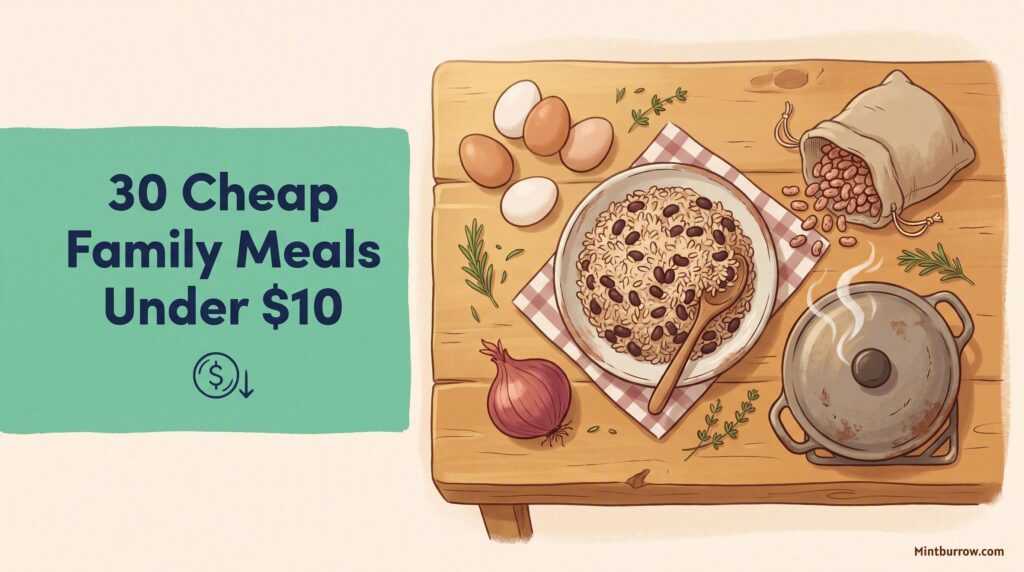
- Rice and beans, done right. A pot of seasoned beans over rice, with an onion cooked down soft and a squeeze of lime. Around $3 for the whole pot. This is the meal that makes the thin week a non-event.
- Bean and cheese burritos. Mashed beans and a little cheese in a tortilla, crisped in a dry pan. About $5 for a stack of them.
- Loaded nachos. Chips, beans, a little seasoned ground beef stretched thin, melted cheese, whatever’s fresh on top. Around $7 and it feels like a treat.
- Red beans and rice. Beans simmered with an onion, celery, and a few slices of cheap sausage for flavor. About $6.
- Bean soup. A bag of beans, an onion, a carrot, salt, and time. Under $4 and it makes enough for two nights.
- Rice bowls with a fried egg. Rice, any cooked vegetable, a fried egg on top, hot sauce. About $4 and ready in fifteen minutes.
- Lentil curry over rice. Lentils cook fast and cheap, simmered with onion and whatever spice you like, spooned over rice. Around $4.
- Refried bean tostadas. Crisped tortillas topped with mashed beans, cheese, and shredded cabbage. About $5.
Built on eggs (fast and cheap)
- Breakfast for dinner. Scrambled eggs, toast, and a pan of fried potatoes. Around $4 and nobody complains.
- Vegetable fried rice. Last night’s rice fried with an onion, an egg, and whatever vegetables need using. About $3 and it clears out the fridge.
- Frittata. Eggs poured over cooked vegetables and a little cheese, finished in the oven. A whole one feeds four for about $4.
- Egg and potato tacos. Scrambled eggs and fried potato in a warm tortilla. About $4.
- Fried egg over greens and toast. A runny egg on sautéed greens on buttered toast. Around $4 and it feels fancier than it costs.
Built on cheap chicken
- Whole roast chicken. A whole chicken is far cheaper per pound than the parts, around $2 a pound. Roast it, and you get dinner plus leftovers plus bones for broth. About $8 and it becomes three meals.
- Chicken and rice soup. Made from that roast chicken’s carcass and scraps. Nearly free once you’ve already bought the bird.
- Chicken thighs and vegetables, one pan. Cheap thighs roasted with potatoes and carrots on a sheet pan. About $8.
- Shredded chicken tacos. Leftover chicken warmed with spices, in tortillas, with cabbage. Around $6 using meat you already cooked.
- Chicken fried rice. Leftover chicken, rice, an egg, frozen peas. About $5 and twenty minutes.
Built on pasta
- Pasta with garlic and oil. Spaghetti, olive oil, a lot of garlic, black pepper, a little cheese. Under $3 and honestly good.
- Baked pasta. Pasta, a jar or pot of tomato sauce, cheese, baked until bubbly. About $6 and it stretches.
- Pasta e fagioli. Pasta and beans in a tomato broth, an old Italian trick for making a little go a long way. Around $5.
- Buttered noodles with peas and egg. Cheap, kid-friendly, and on the table in ten minutes. About $4.
- One-pot tomato pasta. Pasta cooked right in the sauce, one pot, one wash-up. About $5.
Built on potatoes
- Loaded baked potatoes. Baked potatoes with whatever toppings you’ve got, beans, cheese, an egg, green onion. About $5 and endlessly flexible.
- Potato and cabbage skillet. Two of the cheapest vegetables there are, fried together with an onion. Under $4.
- Potato soup. Potatoes, onion, milk, salt. Creamy and filling for about $4.
Use-it-up meals (nearly free)
- Fried rice from leftovers. Cold rice, an onion, an egg, any leftover vegetables or meat, oil and salt. This is the meal I grew up making from last night’s dinner, and it costs almost nothing.
- Fried leftover flatbread. Yesterday’s tortillas or flatbread, fried in a little oil with salt, alongside eggs or beans. Nearly free and better than it sounds.
- Everything soup. Every odd leftover, an onion, a starch, water, salt. Different every time, cheap every time.
- Panzanella (or just good use of stale bread). Stale bread revived with tomatoes, onion, oil, and vinegar. The Italians built a whole dish out of not wasting bread. Under $4.
A few shopping habits that make all of this work
The meals are the easy part. The habits are what keep the bill down week after week.
Buy versatile staples. Flour, rice, beans, eggs, onions, garlic. These show up in a dozen meals, so nothing goes to waste and you’re never truly out of options.
Compare the unit price, not the sticker. The bigger package is usually cheaper per pound, but not always. The little number on the shelf tag that says “per oz” or “per lb” is the one that matters. Get in the habit of reading it.
Buy the cheapest protein on sale, and build around it. Don’t decide on chicken and then pay whatever chicken costs. See what’s cheapest that week, buy extra, and let that decide the week’s meals.
Default to store brands. For staples like flour, rice, beans, and canned tomatoes, the store brand is usually the same thing in a plainer bag for less money.
Stock up when something hits a rock-bottom price. This is the pantry principle in action. When a staple you use is genuinely cheap, buy more than you need. You’re buying it eventually anyway; buy it cheap. Just keep storage in mind so nothing spoils. Rice and dried beans keep for years in a sealed container. Frozen vegetables keep for months.
Waste less. The average American family of four throws away almost $3,000 of food a year, according to the EPA. A weekly leftovers night and a pot of “everything soup” quietly hand a chunk of that back to you.
The thin week, again
Let me go back to that week the money runs thin, because that’s really what this whole article is about.
If your pantry has rice, beans, eggs, an onion, and some cheap staples, that week has a floor under it. Dinner might be rice and beans with an onion cooked soft, and that’s a real meal, it fills everyone up, and it costs next to nothing. Some nights that’s exactly what dinner is at my house, and no one goes to bed hungry. Filling everyone up is the job. It doesn’t have to be fancy to count.
Cheap food carries a lot of shame in this country, like it’s proof you failed at something. I don’t buy that. Feeding your family well on very little money isn’t a failure. It’s a skill, and it’s one of the most useful ones there is. The month the budget is tight, that skill is the difference between panic and just another Tuesday.
If tight grocery weeks are part of a bigger money squeeze, two other things on this site pair well with this one: a plan for [how to stop living paycheck to paycheck], and a simple way to [set a grocery budget you can actually keep]. And if the holidays are the season that always breaks the budget, here’s [how to afford Christmas without going into debt].