The two days that ran my whole month
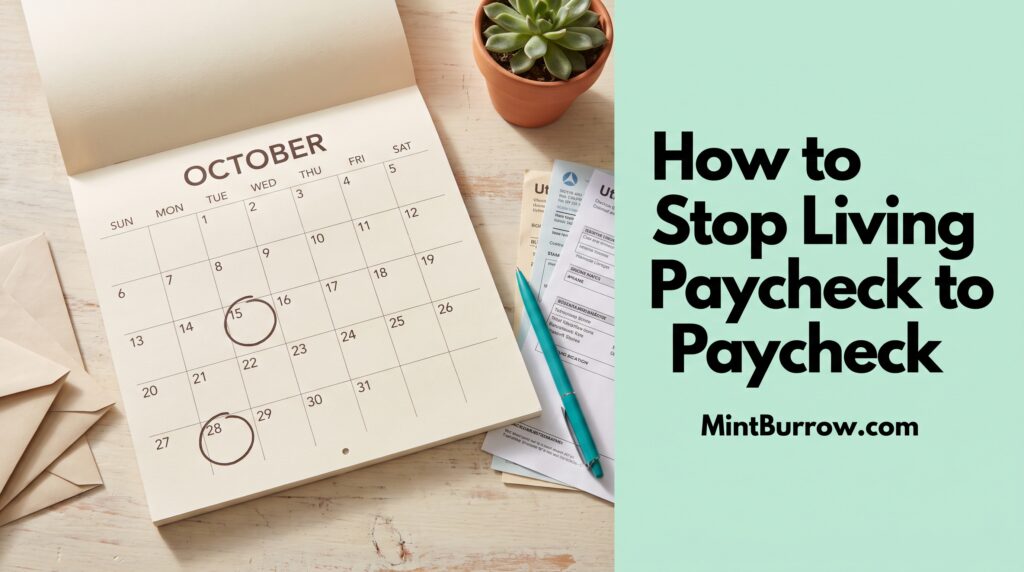
My rent is due on the first of the month. For most of my first year of teaching, my paycheck landed on the third.
Two days. On paper, nothing. In real life, those two days decided how the entire month felt. The last week of every month was quiet math: if I fill the tank on Friday, can the electric bill wait until Monday? If I pay the card minimum today, does the grocery run shrink to rice, eggs, and whatever’s on sale?
Here’s what I want you to notice: none of that was overspending. My money and my bills were simply on different schedules.
Nobody says this out loud. The standard advice is “make a budget and stop wasting money,” as if the problem is always character. Sometimes it is spending — I’ve written about my own [impulse-buying] mistakes. But for millions of people, paycheck to paycheck is a timing problem and a math problem before it’s a willpower problem. And you can’t fix timing with guilt.
So this is the whole plan for how to stop living paycheck to paycheck. Not “skip the latte.” The actual order of moves that takes you from counting days until payday to paying this month’s bills with last month’s money. It works on a low income slower, but it works because I did most of it on a teacher’s salary.
What “living paycheck to paycheck” actually means
The simplest definition: your money runs out at almost exactly the same moment your next paycheck arrives. Nothing meaningful is left over. One surprise expense a car repair, a school fee, a vet bill and something else doesn’t get paid.
How many people live this way? It depends who’s counting, and the gap between the answers is telling.
Bank of America’s research institute, which looks at real spending data from actual accounts, found that nearly 24% of US households spent over 95% of their income on necessities in 2025 housing, groceries, utilities, gas, childcare. That’s their definition of paycheck to paycheck, and it’s a strict one (Bank of America Institute, November 2025).
Ask people directly, though, and the number explodes. PYMNTS Intelligence, which surveys thousands of consumers every month, found 66–71% of Americans described themselves as living paycheck to paycheck across 2025.
Why the huge gap? The bank measures survival spending. The surveys measure something closer to “nothing’s left after the month happens” which includes people earning good money whose costs have quietly expanded to swallow every dollar.
And that second group is bigger than you’d think. A Goldman Sachs survey published in October 2025 found that 41% of people earning $300,000 to $500,000 a year say they live paycheck to paycheck. If a bigger paycheck automatically fixed this, they’d be fine. They’re not which tells you the cycle isn’t only about income. It’s about the gap between what comes in and what goes out, and that gap can be zero at any salary.
One more number, because it’s the honest one: the Federal Reserve found that 13% of American adults could not cover a $400 emergency expense by any means at all (Fed SHED report, 2024 data, released May 2025). If that question makes your stomach drop, you’re exactly who I wrote this for and there is nothing wrong with you.
Why the cycle is so hard to break
Three reasons, and only one of them is spending.
The timing trap. Bills don’t care when you get paid. Rent on the 1st, car insurance on the 7th, paychecks on the 3rd and the 18th and suddenly the first paycheck of the month is gone the day it lands, while the second one feels almost roomy. That imbalance pushes people into overdrafts and late fees during the “heavy” half of the month even when the monthly math technically works.
The fee spiral. This is the cruel part. Run short by five dollars and the bank charges you $26.77 the average overdraft fee in 2025, per Bankrate. Americans paid about $12.1 billion in overdraft and bounced-payment fees in 2024 (Financial Health Network). Those fees land almost entirely on the people with the least buffer, which makes next month tighter, which causes the next fee. Being short of money is expensive.
The mental load. Research by economists Sendhil Mullainathan and Eldar Shafir found that money stress eats attention itself they call it a “bandwidth tax.” When your brain is running background calculations about which bill can slide, you genuinely have less capacity left for planning ahead. That’s not weakness; that’s what scarcity does to everyone. It’s also why “just try harder” advice fails: the trying-harder part of your brain is already fully booked.
How to stop living paycheck to paycheck :eight moves, in order
The order matters more than the speed. Most advice fails because it starts with “save 20%” which is move six when you haven’t done moves one through five.
Move 1: See the whole board
You can’t fix a schedule you’ve never looked at. Take one piece of paper. Left side: every paycheck and the date it lands. Right side: every bill and its due date. Draw a line from each bill to the paycheck that has to cover it.
Most people who do this see the problem within minutes one paycheck carrying 70% of the bills while the other floats. If you’re not sure where the non-bill money goes, start with [Where Does All My Money Go] and then set up a simple plan with [How to Make a Budget That Actually Sticks]. The [50/30/20 calculator] will show you in about a minute what your current split actually looks like and if your needs are over 55%, that’s confirmation this was never about lattes.
Move 2: Move your due dates
Here’s the fix almost nobody uses: you can ask for different due dates. The Consumer Financial Protection Bureau specifically recommends aligning bill dates with paydays, and most credit cards, phone carriers, and utilities will change your date with one call or a few clicks in the app.
The goal: spread the bills so each paycheck carries a similar load, with a few days of cushion after payday. One 20-minute session of calls can end the heavy-half/light-half problem permanently, and it costs nothing. Two notes: changes usually take one or two billing cycles to kick in, and keep autopay minimums on while things shift so nothing slips.
Move 3: Build a small buffer — $500 if you can, $250 if that’s what’s real
Before debt payoff, before real savings: a starter buffer. Its only job is to absorb surprises, so a flat tire never becomes an overdraft fee, a late fee, and a payday loan.
I learned this the hard way. At my first teaching job there was a stretch where the pay simply didn’t come new district, paperwork limbo, and the summer gap teachers know too well. The first two months, I managed. The third month, I started postponing things. The last two weeks, I borrowed about $300 from my brother. A small amount. It still stung in a way I remember years later.
The lesson I took: an emergency fund shouldn’t be sized by a formula like “three months and done.” Bigger is simply better, and it’s never really finished mine kept growing after that, because the point isn’t hitting a textbook number, it’s how many bad weeks you can absorb without borrowing. Start yours with [How to Build an Emergency Fund on a Tight Budget], and use the [emergency fund calculator] to set a first target that fits your actual bills.
Move 4: Plug the leaks — this funds everything else
On a tight income you can’t cut your way to wealth, but you can usually find $50–$150 a month hiding in three places: subscriptions you forgot ([How to Cut Your Monthly Bills]), the grocery store’s tricks ([How to Save Money on Groceries]), and purchases that happen to you rather than because of you ([How to Stop Impulse Buying]). A short [no-spend challenge] is the fastest way to see which spending you don’t actually miss.
That found money isn’t for celebrating. It goes to the buffer first, then to the next moves. This is the engine of the whole plan.
Move 5: Set up sinking funds — the real paycheck-to-paycheck killer
Here’s the pattern that keeps people stuck: the month is fine until it isn’t. Car registration. School supplies. A wedding gift. December. These aren’t emergencies they’re irregular bills you knew were coming but didn’t spread out.
The fix is boring and it works: total cost ÷ months until due = set-aside per month. Car insurance of $600 due in six months? That’s $100 a month, or $50 per biweekly paycheck, quietly moved to a separate pocket. Do this for your two or three biggest irregular expenses and the “bad months” mostly stop existing. Even $25 a month toward the single scariest one changes things.
Move 6: Handle debt without stopping the plan
Minimum payments stay in your bills column always. Extra payments only start once the starter buffer exists, because without the buffer, one surprise expense goes straight back on the card and undoes months of progress.
When you’re ready, [How to Get Out of Debt on a Low Income] covers the realistic version, and the [debt payoff calculator] will show you what even an extra $25 a month does to the timeline. It’s more than you’d guess.
Move 7: Get one month ahead — this is the finish line
Here’s the actual definition of breaking the cycle: this month’s bills, paid with last month’s income. Once that happens, timing stops mattering. Due dates become irrelevant. A late paycheck is an annoyance, not a crisis.
I got there through a habit I didn’t know had a name: I hate watching my account balance get low. Genuinely dislike it. So at the end of each month I’d catch myself thinking “not now I’ll buy it after payday,” not for any particular purchase, just to keep the number from dropping. Turns out that reluctance is a system. The months I skipped the unnecessary stuff clothes I didn’t need, a gadget upgrade the leftover carried into the next month. It didn’t cover the whole month at first. But it covered some days, then more days, and it stacked.
Budgeting folks call this “aging your money.” I call it giving the number a floor. Either way, here’s the honest math on a tight budget: setting aside $300 a month from a $3,000 income takes about ten months to get one full month ahead. That sounds long. It’s also just one school year and every month along the way is calmer than the one before it.
Move 8: When cutting hits the floor, the lever is income
On a low income there’s a point where the budget is honestly clean and there’s nothing left to cut. Past that point, more frugality produces misery, not money. The remaining lever is income and in the survey data, most people who escaped the cycle did it through a raise, a better job, or extra income, not extreme cutting.
I won’t repeat the whole playbook here because I wrote it separately: [Side Income Ideas for People Who Are Already Tired] written specifically for people who don’t have energy for hustle-culture nonsense and [How to Save Money on a Low Income] for squeezing the most from what’s already coming in.
A warning about the apps that “help”
You’ve seen the ads: get your paycheck early, no interest, just a small fee or an optional “tip.”
Be careful. The CFPB found the average user of these paycheck-advance apps took 27 advances a year essentially one every payday, which means the app has become a permanent hole in every check. Add up the fees and tips, and researchers at the Center for Responsible Lending measured costs equivalent to a 367% APR on typical direct-to-consumer advances. That’s payday-loan territory wearing a friendlier app icon. One study found overdrafts actually rose 56% after people started using them.
An advance isn’t extra money — it’s next week’s money, minus a fee, arriving early enough to guarantee next week is short. If you’re using one right now, no shame; it usually starts during a genuinely hard week. But put “stop needing the advance” near the top of your plan, right after the starter buffer.
The part nobody says out loud
One more thing I’ve watched happen to colleagues, to friends, almost to me.
The moment income rises, the lifestyle rises to meet it. New phone the same month as the raise. Better apartment the same year as the new job. And the gap between earning and spending the only gap that ever gets anyone ahead snaps shut again. It’s how someone earning four times more than you can be exactly as broke by the 28th. Remember that 41% of very high earners from earlier? This is how.
You don’t have to live like a monk forever. Upgrade your life later, and slower. Let a raise sit for six months before it changes anything. Get one month ahead first, then improve the lifestyle out of the surplus, not the paycheck. The order is the entire trick.
What the other side feels like
Nothing dramatic happens on the day you break the cycle. There’s no confetti. You just notice, sometime around the 25th, that you haven’t checked your balance in a week because nothing was riding on it.
That’s the whole prize: the quiet. Bills paid on the 1st without checking the calendar first. A car noise that’s an errand, not a catastrophe. Month-end math you do out of habit instead of fear. That’s the whole prize: the quiet.
Start with move one this week one piece of paper, paychecks on the left, bills on the right. And if you want the version with everything laid out for you, the free Budget Planner walks you through it: