
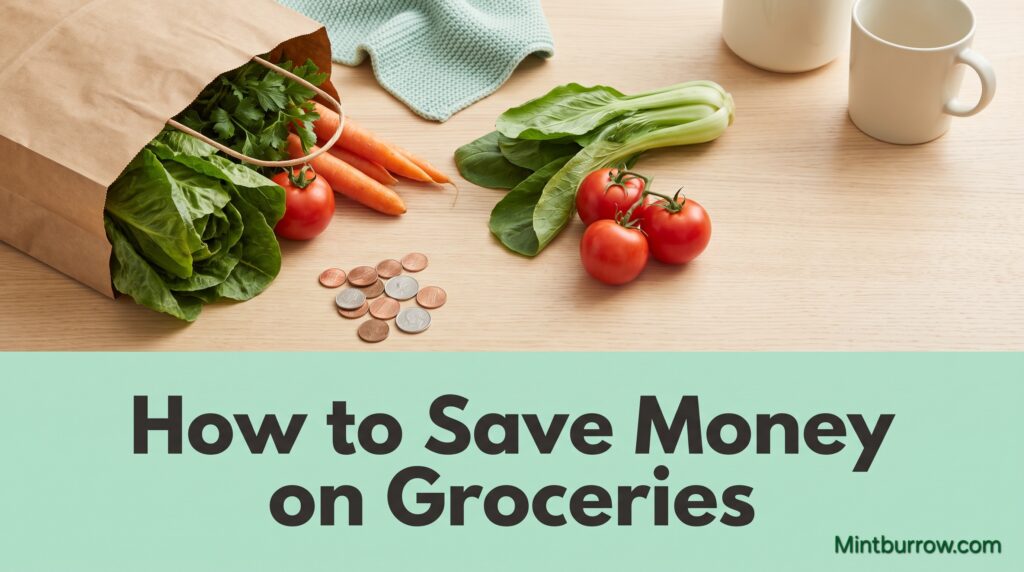
Learning how to save money on groceries starts with one simple truth: the store is working against you. You know that moment at the till? The last item gets scanned, you see the total, and you think, “How is it that much again?” You didn’t buy anything special. Just the usual food. But the number keeps going up.
You’re not wrong. Food costs more than it used to. In fact, a 2025 poll found that 86% of Americans are worried about grocery prices — more than any other money worry. It’s the same story in the UK, Canada, and Australia. And once food prices go up, they almost never come back down.
But here is some good news. Groceries are one of the easiest places to cut costs. You can’t change your rent this month. You can change your next food shop. And you don’t need coupons or a strict diet to do it. You just need to know a few simple things.
Let’s start with the store itself — because it’s not as innocent as it looks.
The store wants you to spend more (here’s how)
Stores are not laid out by accident. Almost everything where things sit, the smells, even the music is set up to keep you inside longer and make you buy more. Once you can spot the tricks, they stop working on you.
Milk is at the back on purpose. Milk, eggs, and bread are things almost everyone buys. So the store puts them right at the back. That way you have to walk past everything else to reach them. The fix is easy: go straight for what you came for. Don’t walk down every aisle.
The best deals are not at eye level. The most expensive brands sit right where your eyes look first. The cheaper store brands are usually up high or down low. So look up and look down that’s where you save money.
The candy is low because kids are small. Sweets and sugary cereals are placed down low, right where children can see them. Then kids ask for them again and again until parents say yes. Stores know this works. If you can, shop without the kids. Or agree on one treat before you go in.
Slow music makes you slow down. One study found that slow background music made shoppers spend over 38% more. Slow music makes you walk slowly, and the longer you stay, the more you buy. Just give yourself a time limit, or play your own music and keep moving.
“Was $5.99, now $2.99” may not be real. A high old price makes the new price feel like a great deal even when the item never really sold at that high price. Don’t trust the big sale sign. Look at the small shelf tag instead. It shows the price per unit (per ounce ), and that is the real number.
There’s also the smell of fresh bread near the door, the big carts that make your shopping look small, and the bright fruit at the entrance that puts you in a happy, spend-y mood. None of it is evil. It’s just business. But once you see it, you shop like someone with a plan.
The biggest mistake: shopping hungry
If you remember only one tip, make it this one. When researchers watched real shoppers, the hungry ones spent 64% more money and not just on food. Being hungry makes you want to grab things.
So eat something before you go. A slice of toast, a banana, anything. It costs you nothing and saves you money every single trip.
Make a plan before you go
The store is good at surprises. Your best defense is to decide what you’re buying before you walk in.
Plan your meals and write a list. Take five minutes to decide what you’ll eat this week. Plan around what you already have at home and what’s on sale. Write it all down. People who plan are far less likely to buy random things. Then the hard part stick to the list.
Always check the price per unit. The big price on the front of the box doesn’t tell you much. The small number on the shelf tag does the price per ounce. Sometimes the bigger pack is cheaper. Sometimes it’s not. This one habit saves money on almost everything.
The swaps that save the most
Once you’re shopping with a clear head, a few simple swaps do most of the work.
Buy store brands. This is the biggest easy win, and most people skip it. Store brands cost about 25% less than name brands. And in taste tests, people often can’t even tell the difference. One expert said a family of four can save around $5,000 a year just by buying store brands and shopping the sales. For most everyday items, you’re paying extra only for the famous name.
Don’t stick to one store. Prices change a lot between shops. The store that’s cheap for one thing is often pricey for another. You don’t need to drive all over town. But if something is always cheaper somewhere else, buy it there. A cheap store like Aldi or Lidl is worth trying once, just to compare your total.
Wait for the sale, then stock up. If you don’t need something right now, wait. Big brands put the same items on sale every six to eight weeks. When something you really use cans, frozen vegetables drops to its lowest price, buy a few, not just one. You’re buying the future at a cheaper price.
Buy in bulk — but only what you’ll finish. Big warehouse stores and family packs can be much cheaper per unit. The bonus deals are real too. But bulk only saves money if you actually eat the food. The average family already throws away over $1,000 of food a year. Good for bulk: rice, frozen veg, toilet paper, and meat you can freeze in portions. Bad for bulk: a giant bag of salad for one person. Before you buy big, ask yourself: where will I keep this, and will I finish it?
Use frozen and seasonal food. Frozen vegetables are just as healthy as fresh, last much longer, and cost less. And fruit and veg that are in season are cheaper and taste better. When something is in season and cheap, eat lots of it that week.
Pick cheaper proteins. Meat is often the most expensive thing in the cart. Beans, lentils, eggs, and canned fish are filling, healthy, and much cheaper. Even swapping one or two meals a week adds up over a month.
Skip the “done for you” price. Pre-cut vegetables, grated cheese, snack-size packs you pay extra for work you can do in two minutes. Buy the normal version and do it yourself.
Let an app help. Your store’s own app is free and often gives you member prices and digital coupons. A cashback app like Ibotta or Fetch pays you a little back on things you already buy. The best trick is to use them together on the same item.
There’s no single “right” way — it depends on you
Here’s something most money articles forget: the best plan is not the same for everyone. What works for a big family would be a waste for someone living alone. So find yourself below.
If you’re a student. Your goal is cheap, filling food and no waste. Build meals around cheap basics rice, pasta, oats, eggs, beans, potatoes, frozen veg. Buy store brands without worry; for getting through the week, “good enough” really is good enough. Cook a big batch and freeze some. And if your campus has a free food pantry, use it. That’s what it’s for.
If you shop for one. Buying for one person is sneaky-expensive, because most packs are made for families. Use your freezer, cook in batches, and split big packs with a friend. Watch out for fresh food that goes bad before you finish it.
If you have a family. This is where buying in bulk really pays off, because you’ll use the big packs. Meal planning is your biggest money-saver. Handle the “can we buy this” battle with a one-treat rule, agreed before you go in.
If money is very tight, or you’re on a fixed income. Build your week around the cheap deals and whatever’s on sale. Shop the cheap stores. Stick to store brands. And if you ever need a food bank or a help program, please use it. It’s there for exactly this, and there’s no shame in it at all.
If money isn’t tight. Then your savings aren’t about pinching pennies they’re about waste. The people who “don’t need” to budget often throw away the most food. A list and a meal plan are still the win. And the money you save can go somewhere far better than the bin.
Turn your savings into real money
Cutting your grocery bill only helps if the money actually goes somewhere. If not, it just slips out on something else. This is where your budget comes in. (If you don’t have one yet, start there first see our guide on how to make a budget that actually sticks.)
Most experts say to keep groceries at about 10–15% of your take-home pay. But here’s the real move: when a few smart swaps save you, say, $150 a month, move that $150 into savings the day after payday — before it can disappear. Saving on food is good. Saving on food and keeping the money is what changes your life.
Start with this, this week
Don’t try to do everything at once — you’ll give up by Thursday. Just pick a few:
- Eat before you shop, and bring a list.
- Swap five name brands for store brands and see if you notice.
- Get your store’s app plus one cashback app.
- Check the price per unit on everything you buy.
- Add up what you saved after a month — then move that money into savings.
This isn’t about going without. It’s about not giving away money for no reason — to a clever shelf, a forgotten list, or a label you’re paying extra for out of habit. Keep what you save, and your future self gets it instead of the store.
Pingback: How to save Money on a Low income (Real Tips)
Pingback: Where Does My Money Go? How to Find the Leaks
Pingback: How to Build an Emergency Fund on a Tight Budget - MintBurrow
Pingback: How to Start a No-Spend Challenge (Without Giving Up by Day Three) - MintBurrow