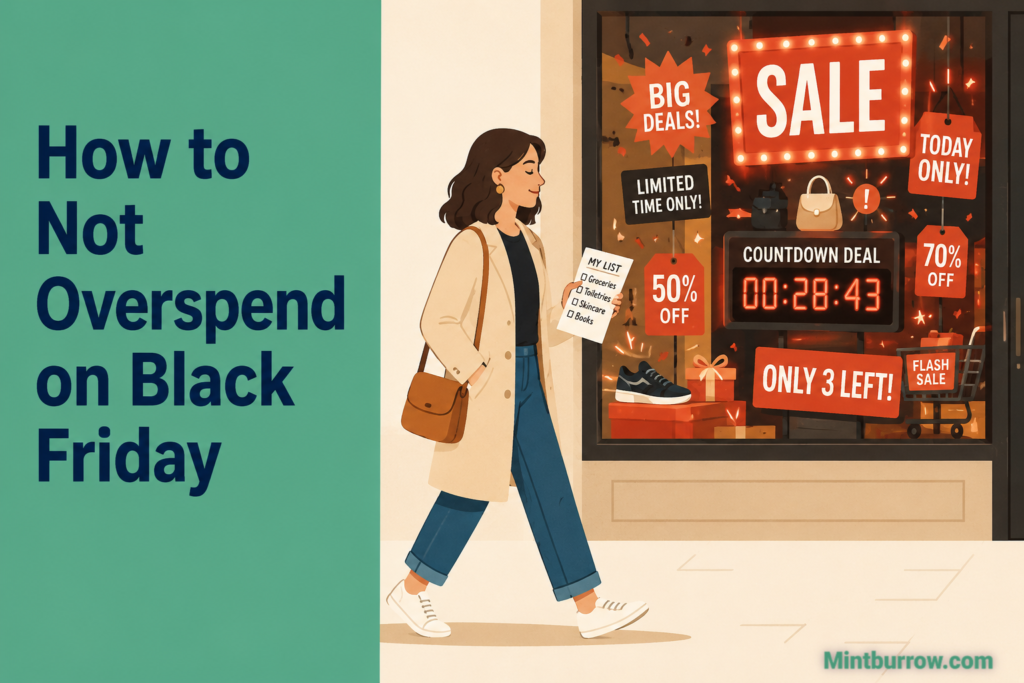
Before you ever saw that countdown timer, someone in a meeting decided how many seconds it would run.
Someone picked which TV would be the doorbuster. Someone tested whether “only 3 left” pulled more clicks than “only 5 left.” Someone set the free shipping bar at exactly $35 because the data showed that number makes people add one more item to the cart.
None of what you see on Black Friday is an accident. It is a machine, built by smart people, tested on millions of shoppers, and tuned every year to do one thing: make you spend more than you planned.
That is not a reason to hate Black Friday. Some deals are real, and I will show you which ones. But if you want to know how to not overspend on Black Friday, the first step is simple. Stop asking “is this a good deal?” and start asking “which trick is this?”
There are six main tricks. Here is each one, how it works on your brain, and the one move that beats it.
Trick 1: The fake “was” price
You see a blender. $89.99, crossed out. Now $39.99. You feel it immediately: fifty dollars saved.
Except a lot of the time, nobody ever paid $89.99. The crossed-out price exists to make the real price look small. Psychologists call this anchoring. The first number you see becomes the measuring stick, and everything after it gets judged against that stick, whether the stick was real or not.
How common is this? A price tracking company called Visualping watched over 1,500 products daily from October through Cyber Monday last season. One third of the Black Friday “deals” were no cheaper than the product had been weeks earlier. The fake deals were, on average, 37% above the product’s actual lowest price of the season. WalletHub ran its own comparison and landed in the same place: about 36% of deals offered no real savings.
Here is the part most people don’t know. The US government has a rule about this. The FTC’s guides against deceptive pricing say a “was” price is only legitimate if the item was truly offered at that price, regularly, for a real period of time. Setting an inflated price just to advertise a big markdown later is called a fictitious former price, and it is exactly what the rule forbids. Retailers dance right up to that line every November.
Your move: Ignore the crossed-out number completely. It is not information, it is a prop. Check the price history instead. CamelCamelCamel and Keepa are free and show you what an Amazon item really cost over the past year. Thirty seconds of checking beats fifty dollars of imaginary savings.
Trick 2: The countdown timer
“Deal ends in 04:59… 04:58… 04:57…”
A timer creates panic, and panic is the point. When you feel time running out, the thinking part of your brain goes quiet and the grabbing part takes over.
Now the fun fact. Researchers at Princeton crawled about 11,000 shopping websites looking for manipulative design. Among the sites using countdown timers, roughly 40% of the timers were fake. They reset when they hit zero, or the “expired” deal simply kept going. A consumer group later caught sellers on Etsy running timers that restarted automatically, over and over, with the price never changing.
Your move: Refresh the page. If the timer resets, you just caught the store lying to you, and you can close the tab with a clear conscience. And even when a timer is real, remember what it is for. A genuine deadline on a thing you already planned to buy is fine. A deadline that made you want something you didn’t want five minutes ago is the trick working.
Trick 3: “Only 3 left” and the crowd
This one I know from the inside.
A few years back there was a phone that sold out in five or six minutes every time stock dropped. I stayed up past midnight with the store page open, waiting. The first drop, I missed it. I barely slept that night. It genuinely felt like I couldn’t compete, like everyone else was faster than me.
Second drop, I got the order in. And the feeling was incredible. Not “I have a nice phone” incredible. More like “I won a game thousands of people lost” incredible. That high lasted about a week. Today I couldn’t tell you one thing that phone did better than a cheaper one.
There’s a book called Influence by a psychologist named Robert Cialdini, and it has a famous experiment that explains exactly what happened to me. People rated cookies from a jar. When the jar held two cookies instead of ten, people rated the same cookies as more desirable and more valuable. But here is the detail that matters: the cookies rated highest of all were the ones made scarce because other people supposedly wanted them. Scarcity plus competition is the strongest pull there is.
And the kicker from that same study: the scarce cookies were not rated as tasting any better. Wanting something more is not the same as it being worth more.
Your move: When you feel that racing, must-get-it-now feeling, treat the feeling itself as the alarm. That arousal is the signal that scarcity is working on you, not a signal that the product is good. Then ask one question: do I want this to use it, or to win it? The phone I fought for at midnight worked exactly as well as it would have a calm month later, at a lower price.
Trick 4: Doorbusters and the mystery model number
That $299 huge-screen TV in the Black Friday ad is doing a job, and the job is not “be a great TV.” The job is to get you in the store or onto the site, where the store makes its money on everything else you grab while you’re there.
It gets sneakier. Consumer Reports and other reviewers have documented that manufacturers build special stripped-down versions of TVs just for Black Friday. Same brand, similar-sounding name, unique model number. Fewer ports, dimmer panel, cheaper parts. The unique model number is not random. It exists so you cannot look up reviews or compare prices, because that exact model doesn’t exist anywhere else.
Your move: Google the exact model number before you buy. If a “deal” TV has almost no reviews while the brand’s regular models have thousands, you have found a derivative model. Walk away, or at least know that you are buying a different, lesser product than the one the brand is famous for.
Trick 5: Free shipping that costs you $25
“Add $6.50 more for FREE shipping!”
So you add a $25 thing you didn’t want to avoid a $7 fee. Congratulations, you paid $25 to save $7.
Free does something strange to the brain. It doesn’t feel like a lower price, it feels like no risk at all, and the brain leaps at it. There is a well-known case from Amazon’s early free shipping days. Sales jumped in every country except France. Why? The French site had priced shipping at one franc, about 20 cents, instead of zero. Nearly free did nothing. When France switched to fully free, sales jumped there too. The gap between 20 cents and zero was worth more to shoppers than the gap between $10 and 20 cents. That is not math. That is a button in your head, and retailers know where it is.
I have pressed that button myself. I once financed a WiFi router because a cashback app was offering a reward slightly bigger than the financing fee. On paper I came out about twelve dollars ahead. But honestly, I never saw the twelve dollars. What I saw was a new router coming to my door, approved and justified, because the deal made it feel free. I was using my phone’s hotspot just fine before that. Two months later I switched internet providers and the router became a paperweight. It is still sitting in a drawer.
The deal wasn’t the reason I bought it. The deal was the permission.
Your move: When free shipping asks you to add more, do the naked math out loud: “I am about to spend $25 to avoid a $7 fee.” Say it exactly like that. The trick only works in the fog; the sentence clears the fog. And when any deal makes a purchase feel justified, ask what you were doing before. If the answer is “managing fine,” the deal is permission, not savings.
Trick 6: The cart trap
Retailers love it when you add to cart, make an account, save your payment details, sign up for early access. Every small step matters to them, even if you buy nothing that day.
Here’s why. Each small yes makes the next yes easier. You joined the waitlist, so you check the drop. You added it to the cart, so it feels half-yours already. You entered your card, so checkout is one tap. By the time the “sale” starts, you are not deciding whether to buy. You decided days ago, one tiny step at a time, and Black Friday just collects the signature.
Car dealers have run this play forever: get a small commitment first, and the big one follows. Online stores just automated it.
Your move: Use the cart as a waiting room, not a checkout line. Add whatever you want, then close the tab and wait 48 hours. If you still want it in two days, at that price, with your own money, buy it happily. Most of the time, you won’t. In my experience the wanting fades fast once I’m home and busy, because the only things that stay in my head are the things my daily life uses.
The people who never overspend do something different
Every article on this topic tells you to fight temptation with willpower. Make a list. Set a budget. Resist.
Fine advice. But watch the people around you who never have money trouble in November, and you’ll notice something odd. They are not resisting anything. On Black Friday they behave completely normally, because the sale never reaches them in the first place.
They are not scrolling shopping apps every day, so they don’t know what’s 40% off. They don’t go to stores to “look around,” they go when they need something. And here is the pattern I keep coming back to: when you need a thing, it’s never on sale. When everything’s on sale, you don’t need anything. Need and sale almost never meet. The people who stay calm have simply stopped treating the sale as an event in their lives.
The deepest version of this is what one of the calmest people I know put into words: don’t leave your mind free enough for shopping to enter it. He fills his time with training, side income ideas, planning trips. Not because he’s disciplined about deals, but because there’s no empty slot where “I wonder what’s on offer” could live. Willpower fights the thought. A full life never has the thought.
You don’t have to become a monk. But two practical versions of this work for anyone:
Unsubscribe from every retailer email in early November. You cannot want a deal you never see.
Look at your actual bank balance right before you browse. Real numbers have a way of ending imaginary savings.
When Black Friday is worth it
Now the honest part, because this is not an anti-shopping article. Black Friday truly is the best time of year for a few categories: TVs, laptops, tablets, headphones, and small kitchen appliances routinely hit their yearly lows in late November. If you need one of those, planned for it, and saved for it, November is your month.
Notice the order there: need, plan, save, then shop. Not see, want, justify, then finance.
Patience inside a category pays too. I needed a laptop for work and waited for the right moment instead of the loudest one. I paid around $650 for a machine with a mid-range gaming card. A friend bought the same specs in a hurry and paid about $950. Same laptop. The only difference was that I shopped on my schedule and he shopped on the store’s.
And know when to skip Black Friday entirely. Mattresses and large appliances go just as low around Presidents Day, Memorial Day, and Labor Day. TVs dip again right before the Super Bowl. Holiday decorations, bedding, and fitness gear bottom out in January. If it’s not on the November list, waiting costs you nothing.
One more filter that has saved me real money: if the cheaper thing you already own does the job, the upgrade isn’t a deal at any price. I write on a basic Windows laptop. It does everything I need. A gorgeous discounted MacBook would not make my writing better, so its discount is irrelevant to me. A deal on something you don’t need is just spending with better marketing.
What overspending costs in real dollars
Quick reality check, because the stakes are real money, not points in a game.
Last holiday season, 37% of Americans took on debt for the holidays, averaging $1,223, according to LendingTree. Almost half of them said they regretted how much they spent. And with the average credit card now charging around 22% interest on carried balances, that $1,223 doesn’t stay $1,223 for long. Buy-now-pay-later makes it even easier to lose track: shoppers put over $700 million on BNPL on Black Friday alone last year.
The machine is very good at getting the money out. It is nowhere around in January when the statements come.
How to Not Overspend on Black Friday : The Ten-Minute Plan
If you only do this, you’ll beat 90% of the tricks above:
- Write your list now, in early November. Names and items. Nothing gets bought that isn’t on it. (If you already run a Christmas budget, this is the same list.)
- Set the total you can spend in cash, ideally from money you set aside in advance. A sinking fund built through the fall makes Black Friday feel completely different: you’re spending saved money, not future money.
- Unsubscribe from retailer emails the first week of November.
- For anything on the list, check price history the week before, so you’ll know a real deal from a costume.
- Use the 48-hour cart rule for anything that wasn’t on the list.
- If you feel the racing feeling, name the trick. There are only six.
Black Friday is a machine built to make you overspend, and you cannot make the machine stop. But you can walk past it. The timers, the crossed-out prices, the “only 3 left,” none of it works on someone who knows what they came for, knows what it usually costs, and knows that the scarce cookies never tasted any better.
If impulse buying is a year-round struggle and not just a November one, I wrote a whole [guide on how to stop impulse buying] impulse article that pairs well with this one.