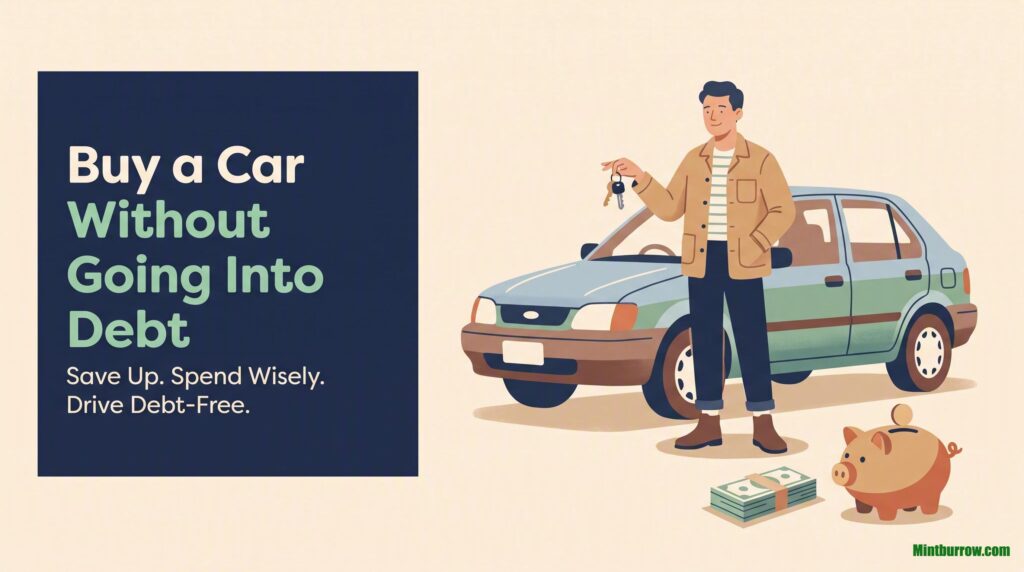
A new car in America now costs about $49,758. The average new-car payment just hit a record $777 a month. And here’s the part that should stop you cold: almost a third of people trading in a car still owe money on it, an average of $7,183 that they roll into the next loan. They’re paying for a car they don’t even own anymore, on top of the one they’re driving now.
That’s not a car problem. That’s a “bought it before they were ready” problem.
I want to talk about how to buy big things, a car especially, without one of them quietly wrecking your finances. And I’m not going to give you the usual lecture where loans are evil and you must pay cash for everything or you’ve failed. That’s not real life, and it’s not what I believe. I’ve financed a big purchase myself. The question was never “loan or no loan.” The question was whether I was ready.
Let me show you what “ready” really means, because that’s the whole game.
How to buy a car without going into debt that owns you
Forget the moral stuff about debt for a second. Here’s the only question that matters when you’re about to buy something big:
If this purchase goes through, does it barely touch your financial life, or does it put you on the edge?
That’s it. A big purchase is safe when you’ve set things up so it doesn’t really move your standing. It’s dangerous when one payment, one bad month, one surprise, tips the whole thing over. Whether you financed it or paid cash is almost beside the point. What matters is the cushion around it.
Here’s how I think about being ready, and it’s the rule I use:
Your income source has to be solid first. Before the big thing, you need money coming in that you can count on, on a schedule. Not “I’ll figure it out.” A real, steady source. The purchase comes after the income is proven, never before.
After the payment, you still have room. Run the actual numbers. If you take this on, is there still enough for your normal expenses AND for savings? If the answer is “it’ll be tight but I’ll manage,” you’re not ready. Tight is how people end up underwater.
The thing doesn’t change your status much. This is the heart of it. Buy in a way where, if you lost the item tomorrow or the market moved, you’d be annoyed, not sunk. The goal is a purchase that sits lightly on your life, not one you’re bracing under.
Notice what’s not on that list: “never borrow.” Because that’s not the real danger. The real danger is buying something big before your setup can hold it.
Why the “just finance it” crowd gets hurt
So if loans aren’t automatically bad, why do so many people get crushed by them?
Because they skip the “ready” part entirely. They see a small down payment and an easy monthly number and they buy. The setup underneath, the steady income, the room after the payment, the cushion, was never there. The loan didn’t hurt them. Buying before they were ready did.
The 2026 numbers show exactly how this plays out. Car loans now stretch to 84 months for almost a quarter of buyers. One in five new-car buyers has a payment over $1,000 a month. And subprime borrowers are falling behind at the highest rate in 32 years. These aren’t people who “financed a car.” These are people who bought more car than their setup could hold, and the payment slowly ate everything else.
There’s also a quieter trap, and I’ve felt it myself. When a payment comes out on autopay, you stop feeling it. The money leaves automatically and your brain files it under “already gone.” That’s genuinely useful if you’re a planner, you’ll never miss a due date or eat a late fee, and you already budgeted for it. But if you’re not planning, autopay is how a purchase disappears from your mind while it keeps draining your account. You bought it once and felt the excitement once, and then the cost just quietly runs in the background for six years. No pain, no attention, no brake. That’s how people end up with three payments they’ve half-forgotten about.
The fix isn’t “never use autopay.” It’s “only put a payment on autopay that you already planned for and can name off the top of your head.”
The trick that saves you more than money: wait first
Here’s the move that changed how I buy big things, and it barely costs anything: before you buy, make yourself save toward it first. Even if you could swing the payment today, save for it first anyway.
Two things happen when you do this.
The obvious one: you end up with cash, which means a smaller loan or no loan, which means less interest and more cushion.
The one nobody tells you about: the waiting shows you whether you even wanted it.
I learned this with a graphics card. I wanted one badly, a whole gaming PC build in my head, all the games I’d play. I didn’t have the money, so I started saving and I made myself wait. And I won’t pretend the waiting felt great, it was a little painful. But something funny happened. The wanting faded on its own. By the time I could have bought it, the itch was gone.
I never bought it. And looking back, I’m glad. If I’d bought it, I’d have gotten a little fun for a few weeks and then that excitement would have died anyway, same as it did while I waited, except I’d be out the money with nothing productive to show for it. The waiting didn’t just protect my wallet. It told me the truth: I didn’t need the thing. I just wanted the feeling, and the feeling was temporary.
Saving first beats buying now even when you can afford the payment. A payment locks you in before you know if the want is real. Saving first lets the fake wants burn off before they cost you anything. Half the big purchases you talk yourself out of during the saving period are purchases you dodged, not sacrifices you made.
How to save for a big purchase, step by step
If you decide the thing is real and you want it, here is the boring method that works.
Take the price. Divide it by the number of months you’re willing to wait. That’s your monthly number. Fifteen thousand dollars over twelve months is $1,250 a month. Too steep? Give it more time, or aim at a cheaper version of the thing. A separate savings account you don’t touch, with an automatic transfer on payday, does the work for you. This is just a sinking fund, the same quiet trick that works for Christmas or car repairs, pointed at a big goal.
And when a windfall lands, a tax refund, a bonus, a bit of extra work, throw a chunk of it at the goal instead of letting it melt into everyday spending. One good windfall can jump you months ahead.
Buy the thing that’s had its worst drop already
Now the car-specific part, because cars have one cruel feature: they lose value fast, and fastest when brand new.
A new car loses roughly 20% of its value in the first year and around 60% over five years. Picture a $48,000 car worth about $19,000 five years later. The person who buys it new eats that entire drop. That’s real money, gone, whether you paid cash or financed it.
So let someone else eat it. A car that is two or three years old has already taken the steepest fall. It’s often barely different from new, frequently still under some warranty, and you’re paying a fraction of that lost value instead of causing it. This is exactly what quietly wealthy people do. In the research on American millionaires, most weren’t buying brand-new cars at all, they bought good value and drove it for years. They didn’t get rich because they could pay cash for new cars. They stayed rich partly because they refused to.
One honest note: the people I know who are smart with money don’t all avoid loans or always buy used. Some put a small amount down and keep the rest of their cash working elsewhere. Some buy new on purpose, because they’ll run a car for a decade or use it to earn a living, and a reliable new one pays off over that long haul. That’s fine, that’s a plan. The difference is they ran the math and their setup holds it. They’re not buying new to look new. They’re buying with a reason and a cushion.
Before you hand over the money on a used car
If you go the used route, protect yourself:
Get an independent mechanic to inspect it before you buy, someone who doesn’t make a dime off the sale. If the seller won’t allow an inspection, walk away. That refusal is the whole answer.
Check the title is clean, no salvage or rebuilt history, and that the VIN on the paperwork matches the car. Run the history report and make sure the mileage and story line up. Favor one-owner cars with records.
“Certified pre-owned” can mean a real manufacturer-backed warranty, or it can just be a dealer sticker. Ask which one, and get it in writing. A clean private-party car that passes an inspection is often the better deal for someone paying with their own money.
This works for more than cars
The same logic covers every big purchase, a laptop, a phone, appliances, furniture. Save for it first in its own little fund. Buy slightly used, refurbished, or open-box when you can. And be very careful with store financing and “buy now, pay later,” which is built to make you skip the “am I ready” question entirely. Those plans are popular precisely because they let people buy things they can’t quite afford, one painless-looking installment at a time. That’s the same trap as the car, just smaller.
The one thing to remember
You don’t need to swear off loans to be good with money. Plenty of sensible people finance things, and do it fine.
What you need is to stop buying big things before your setup can hold them. Get the income solid first. Make sure there’s room after the payment. Save toward it long enough to find out if the want is even real. And buy in a way where the thing sits lightly on your life instead of balancing on top of it.
Do that, and it doesn’t much matter whether you paid cash or signed a loan. Either way, the purchase can’t shake you. And not being able to be shaken is the entire point.
If saving toward a big goal is the part you get stuck on, [sinking funds]are the exact tool for it. If the pull to buy the shiny new version is what gets you, here’s [how to stop impulse buying]. And if a payment you already signed for is squeezing you right now, start with [how to get out of debt on a low income].