A quick, honest note before anything else. This is about paying less for care, not getting less of it. If something is wrong, please don’t tough it out to save a few dollars. What follows is how to save money on healthcare while still getting the care you actually need, because in this country those are two different things.
Here’s what almost nobody tells you: the sticker price is rarely the real price. That bill that shows up looking like a phone number is usually a starting point, not the final word. I watched this up close. Someone in my family landed in the hospital, the bill was frightening, and once we dug into the help that was actually available, more than half of it went away. The care was exactly the same. The price wasn’t. Let me walk you through where that savings hides.
How to Save Money on Healthcare: Start With the Bill
If you take one thing from this whole article, take this. Most hospitals are legally required to help people who can’t afford their bills, and most patients never find out it exists.
More than half of US hospitals are nonprofits, and by law those hospitals have to keep a written financial assistance policy, sometimes called charity care. If your income is low enough, it can wipe out your bill completely or cut it down on a sliding scale. As a rough guide, many hospitals give free care to people at or below twice the federal poverty line, which in 2026 is about $31,920 a year for one person or $66,000 for a family of four, with partial discounts above that. Every hospital sets its own cutoffs, so the only way to know yours is to ask.
A few things that make this so powerful:
- You usually have at least 240 days after your first bill to apply. That’s about eight months. A scary bill today is not a closed door.
- You can apply even if the bill already went to collections. If they approve you, they have to pull it back out.
- This is not welfare and it’s not a favor. It’s a policy the hospital is required by law to have.
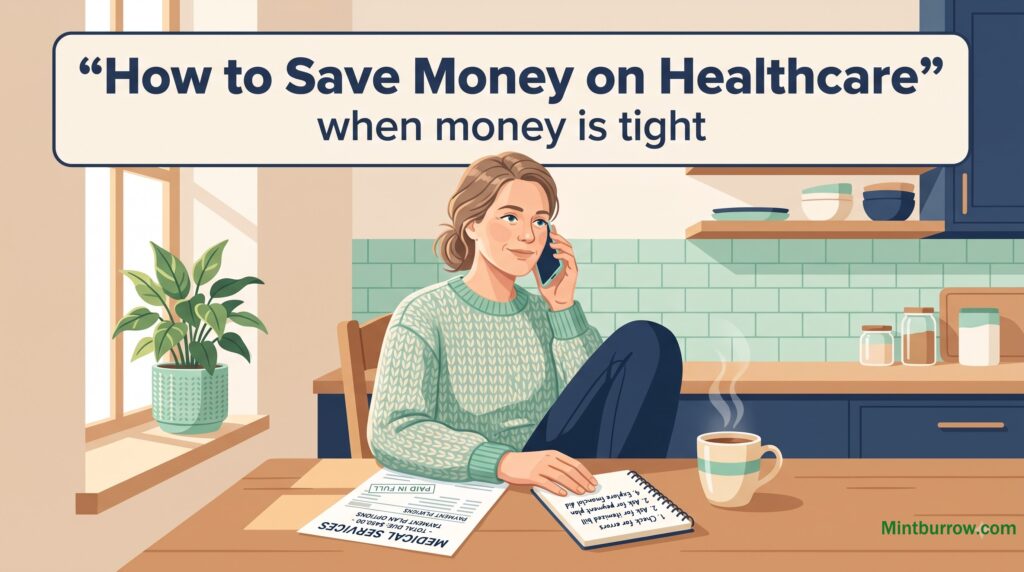
To start, call the hospital’s billing office, say you want to apply for financial assistance, and ask them to send you the application and a copy of their financial assistance policy. A nonprofit called Dollar For walks people through this for free, and it’s worth a look if the paperwork feels like a wall. Whatever you do, don’t ignore the bill and hope it disappears. Ignoring it is the one move that actually costs you. Asking is the move that saves you.
Get the itemized bill and negotiate
Even after any assistance, whatever’s left is often negotiable. Hospitals expect it.
Start by asking for the itemized bill, the full line-by-line version, not the short summary. Then hold it up against the Explanation of Benefits your insurer mails you, the page that says “this is not a bill.” Billing errors are common, and you’re hunting for anything you were charged for that didn’t happen, or charged for twice.
Then a few asks that regularly work:
- Ask for the cash or prompt-pay discount. If you can pay something now, a lot of places will knock off a chunk.
- Ask for an interest-free payment plan. Most hospitals offer them, and zero percent beats a credit card charging you 25% a month.
- If you’re uninsured or paying on your own, you’re entitled to a Good Faith Estimate, a written estimate of what a service should cost, up front. Ask for it before, not after.
You don’t need to be slick about it. A plain line does the job:
“I want to pay this, but I can’t pay it all at once at this amount. Can we look at a prompt-pay discount, or a payment plan that fits my budget?”
Prescriptions have more than one price
People assume a prescription has a fixed price. It doesn’t. The same pill can cost wildly different amounts at two pharmacies a block apart.
- Ask for the generic. A generic is the same medicine, held to the same FDA standards, just without the brand name and the markup that comes with it. Cheaper here does not mean weaker. It’s the identical drug.
- Check a discount tool before you pay. Apps like GoodRx or SingleCare show the cash price with a coupon, which is often less than your insurance copay. Two catches: you can’t stack a coupon on top of insurance, and coupon spending doesn’t count toward your deductible.
- Ask about a 90-day supply. It’s often cheaper per pill than buying a month at a time.
- For pricey brand-name drugs with no generic, look up the maker’s patient assistance program. Free nonprofit databases like NeedyMeds and RxAssist list them.
One real-life note. I know people who finish their full course of medicine but buy it in smaller amounts because they can’t lay out the whole cost at once. If that’s you, finishing the course is exactly right, so don’t skip doses. Just price it out with a generic, a coupon, or a 90-day supply first. Often the whole course, bought at once, ends up cheaper than you feared.
The most expensive bill is the one you saw coming
Here’s a trap that catches hard workers especially. When you’re busy earning, you don’t ignore your health to save money on purpose. You just don’t notice the small signals, the ache, the thing that’s a little off, until it grows into something big and expensive. The cheapest care is almost always the care that keeps a small problem small.
So don’t skip the basic stuff to save a few dollars now, because it tends to cost you more later. And if the price of a checkup is what’s stopping you:
- Community health centers (you’ll see them called FQHCs) charge on a sliding scale based on your income. Some visits cost very little, some are free.
- Free and charitable clinics exist in most areas.
- If you have a marketplace health plan, preventive care like checkups and screenings is supposed to be free, with no copay.
And one more thing, from experience. If something feels wrong, don’t stop at a single “everything looks normal.” Someone close to me had a mild, nagging chest pain, and test after test came back fine. We kept pushing, saw a few different doctors, and eventually one caught what the others had missed and treated it. It cost a bit more to keep going. It was the best money we ever spent. Your gut is allowed to overrule one clean report.
There’s a book about money that makes a point I keep coming back to: you have to plan on your plan not going according to plan. Health is the clearest example there is. You can’t predict the emergency. But you can keep a small cushion, even twenty dollars a month into a “medical” envelope, and you can learn the escape hatches, charity care, payment plans, sliding-scale clinics, before you ever need them. That little bit of room is what keeps one bad week from turning into years of debt.
Insurance, without the headache
If you don’t have coverage, it’s worth a fresh look, even if you’ve long assumed it’s out of reach.
- Open enrollment for marketplace plans runs each fall, starting November 1. To be safe, enroll by December 15, which locks in coverage that starts January 1. Some states give you until mid-January, so check yours.
- Heads up for right now: the extra subsidies that made marketplace plans so cheap lapsed at the end of 2025, and as of 2026 Congress hasn’t renewed them, so prices jumped. Don’t assume you can’t afford anything. Go to HealthCare.gov and see your real price with whatever help you still qualify for, because a lot of people still do.
- If your income is very low, you may qualify for Medicaid, which is free or close to it. It depends on your state.
- Don’t just grab the cheapest premium. A rock-bottom plan can carry a deductible so high you still can’t afford to use it. Look at the whole picture, not only the monthly number.
Skip the HSA hype
You’ll see plenty of advice to open a Health Savings Account. For most people on a tight budget, it isn’t the win it’s made out to be. The tax break is only worth much if you’re in a high tax bracket, you need spare cash to fund it in the first place, and many of these accounts are loaded with fees and pay almost no interest. The bulk of the benefit goes to high earners. If money is tight, your energy is far better spent on everything above.
A quick win for your credit
If a medical bill hurt your credit, check the details. The credit bureaus now leave off medical collections under $500, and anything you’ve already paid. So a smaller bill shouldn’t be dragging your score down, and if it is, dispute it with the bureaus.
The one number to remember
Here’s how I think about all of this. Money is really just your time and energy in another form. Which means the afternoon you spend on the phone asking for financial assistance, filling out one form, or comparing one drug price might be the best-paid work you do all year. An hour of asking can erase thousands of dollars. Not many things pay that well.
That’s how to save money on healthcare without cutting the one corner you shouldn’t, which is your own health. You’re allowed to get the care you need. Just don’t pay the first number they show you.