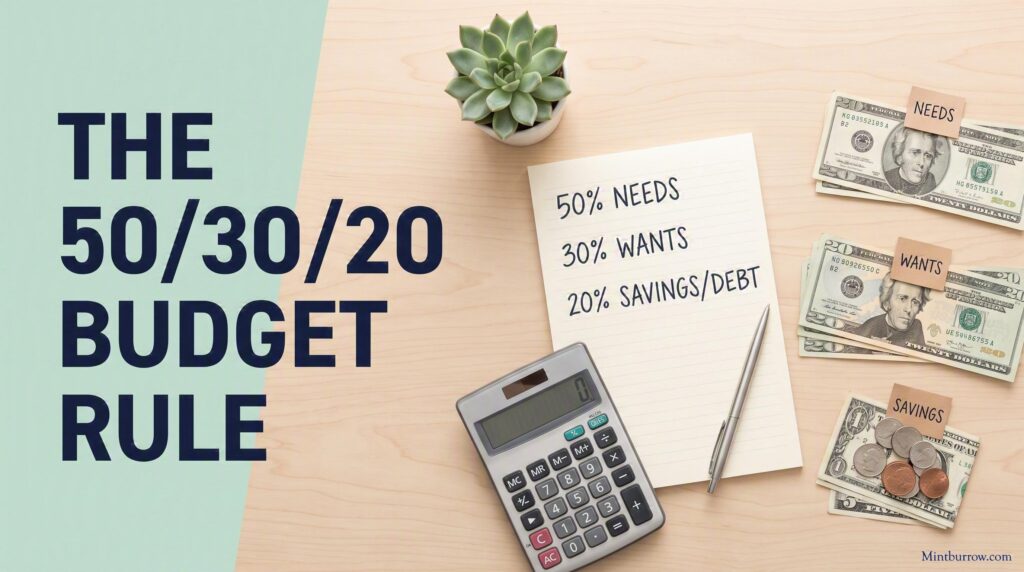
If you’ve spent five minutes looking up how to budget, you’ve met the 50/30/20 budget rule. It’s the one everyone starts with three tidy numbers, no spreadsheet, no tracking every coffee. Put half your money toward needs, a third toward wants, a fifth toward savings, and you’re done.
It’s a good place to start. But here’s what most articles won’t tell you: for a lot of people, the math simply doesn’t add up and that’s not your fault. So let’s do this honestly. I’ll explain exactly how the rule works, show you the numbers at a few income levels, and then get into the part that actually matters: what to do when 50/30/20 doesn’t fit your life.
What the 50/30/20 budget rule actually is
The rule comes from a 2005 book called All Your Worth, written by Elizabeth Warren (yes, the senator back when she was a bankruptcy professor) and her daughter Amelia Warren Tyagi. Their idea was to make budgeting simple enough that a normal person would actually stick with it. You split your take-home pay into three buckets:
- 50% for needs — rent or mortgage, utilities, groceries, insurance, transport, and the minimum payments on any debt. The stuff you genuinely can’t skip.
- 30% for wants — eating out, streaming, hobbies, a nicer phone, travel. Things that make life good but aren’t survival.
- 20% for savings and debt — your emergency fund, retirement, investments, and any extra debt payments beyond the minimum.
One thing that trips people up: it’s based on your take-home pay the money that actually lands in your account after tax not your gross salary. So if $4,000 hits your bank each month, the rule works off that $4,000.
A quick example (with real numbers)
The easiest way to see it is a simple table. Here’s the 50/30/20 split at a few monthly take-home amounts:
| Monthly take-home | Needs (50%) | Wants (30%) | Savings & debt (20%) |
| $3,000 | $1,500 | $900 | $600 |
| $4,000 | $2,000 | $1,200 | $800 |
| $5,000 | $2,500 | $1,500 | $1,000 |
| $6,000 | $3,000 | $1,800 | $1,200 |
50/30/20 Budget Calculator
Enter your take-home pay to see your split. Then, if you like, add what you actually spend — and see where the gap is.
Now, what do you actually spend each month? (Leave blank to skip.)
Remember: this is a starting point, not a rule. If your needs already cost more than half your income, you haven’t failed — the maths just doesn’t fit today’s cost of living. Adjust the ratio to your real life.
Based on take-home (after-tax) pay, as in Elizabeth Warren’s All Your Worth. Minimum debt payments count as needs; anything extra counts as savings. General information, not financial advice.
That’s the whole system. Find your take-home number, split it three ways, and you’ve got a budget you can run in your head.
Needs vs. wants: it’s more personal than it looks
Most guides hand you a fixed list housing is a need, restaurants are a want and move on. But in real life, the line between a need and a want depends on your life, and getting this right matters more than the percentages.
The basics are the basics for everyone: food, a roof, clothes, electricity, getting to work. Those are needs. A costly outfit when a cheaper one does the job, or dinner out when there’s food at home those lean toward wants. Simple so far.
But the same thing can be a need for one person and a want for another. If your income depends on how you present yourself say your work is client-facing then good clothes might genuinely be a need, not vanity. The mistake is copying someone else’s list. You have to look at your own life and be honest about what actually earns its place, because the moment you start living by somebody else’s definition of “need,” you lose. Analyze your own lifestyle first. Then decide.
That single habit sorting your real needs from your inherited wants does more for your budget than any ratio.
Why the rule is so popular
The appeal is obvious. It’s simple: three numbers instead of forty line items. It’s beginner-friendly, so it doesn’t scare off people who’ve never budgeted. It builds a savings habit from day one by baking in that 20%. And it’s flexible you’re anchoring to percentages of your income, not rigid dollar amounts, so it scales as you earn more.
That’s why banks, financial planners, and budgeting apps all point beginners here. As a starting framework, it does its job.
When the 50/30/20 budget rule doesn’t work
Here’s the honest part. The 50/30/20 rule assumes your needs fit inside half your income. For a huge number of people, they don’t and no amount of discipline changes that.
Look at the actual data. In 2024, housing and transportation alone ate up 50% of the average U.S. household’s spending. Add groceries, insurance, and utilities on top and you’re well past the 50% “needs” cap before you’ve bought a single want. Half of American renters now spend more than 30% of their income on housing, and millions spend more than half. Meanwhile the average American saves only about 4.5% of their income not the 20% the rule prescribes.
So if you’ve tried 50/30/20 and felt like a failure when your needs came to 65% or 70%, understand this clearly: you didn’t fail the math. The math changed. The rule was written for a different cost of living.
Here’s where it commonly breaks:
- High rent areas. In expensive cities, rent by itself can pass 50% of take-home. The needs bucket is blown before anything else.
- Lower incomes. When you earn less, essentials swallow a much bigger share. Needs at 70%+ isn’t overspending it’s arithmetic. (If this is you, our guide on saving money on a low income goes deeper.)
- Heavy or high-interest debt. The rule lumps a 6% student loan and a 24% credit card into the same “20%.” If high-interest debt is crushing you, you may need to throw 30–40% at it for a while paying off a 24% card is a guaranteed return no savings account can match.
- High earners. Flip side: if you make good money, saving only 20% and spending 30% on wants can be lazy. You could bank far more and hit your goals years sooner.
This is the core problem with any one-size formula. Which brings me to how I’d actually approach it.
I’ll be straight with you: I don’t think anyone should follow 50/30/20 exactly, because everyone’s needs are different. For one person 40/40/20 works; for another it’s something else entirely. If you’re going to use a ratio, build your own version around your actual life not a number from a book.
The way I run my own money is simple. The moment my salary comes in, the first thing I do is cover my bills and fixed expenses. Then and this is the part that matters I move a fixed amount into savings. Not “whatever’s left.” A set number I’ve decided in advance. If I earn $6,000 and my monthly expenses are $2,000, then after paying everything I’ll transfer something like $2500 straight into savings.
And here’s a trick that’s done more for me than any budgeting app: keep your savings in an account that’s hard to reach. no checkbook , no easy access. If getting to the money takes effort, you won’t raid it for something you don’t need. Out of sight, genuinely out of mind.
Now, a lot of budgeting experts would push back on my order. They teach “pay yourself first” move your savings the instant you’re paid, before bills, so saving never becomes an afterthought. It’s a fair point, and honestly, if you’re the type who spends whatever’s sitting in your account, do it their way: save first, live on the rest. The research backs it up.
But whichever order you choose, the real lesson is the same, and it’s the thing most people miss: your savings should be a fixed, planned number not the leftovers. The reason my “bills first” approach works is that I already know my expenses before the month starts, so there’s no guessing. Most people struggle for two reasons: they never actually changed their lifestyle to fit their income, and they save a random amount without analyzing their spending first too much one month so they’re short, too little the next so it never adds up. Fix those two things and the order barely matters.
If 50/30/20 budget rule doesn’t fit, try one of these
Ratios aren’t sacred. If yours needs adjusting, here are common alternatives:
- 60/30/10 — 60% needs, 30% wants, 10% savings. A realistic starting point when housing and essentials are high. You save less at first, but you actually stick to it.
- 70/20/10 — 70% living costs, 20% savings, 10% for debt or giving. Good when essentials are heavy but you still want a savings floor.
- 80/20 (pay yourself first) — save 20% off the top automatically, spend the other 80% however you like. Minimal tracking.
- Zero-based budgeting — give every single dollar a job before the month begins. More hands-on, but powerful if your income is irregular or your debt is heavy.
Pick the one closest to your reality, then improve it. Shift one percent from spending to savings each year. Progress beats a perfect ratio you’ll abandon by week three.
The bottom line
The 50/30/20 rule is a good door to walk through. It’s simple, it’s memorable, and it gets people who’ve never budgeted to finally start. Use it for that.
But don’t let three numbers make you feel broken. The rule assumes a cost of living that a lot of us don’t have anymore. If your needs run past 50%, that’s information, not failure it tells you where to focus, whether that’s cutting costs, growing your income, or building a ratio that fits your actual life.
Start where you are. Change your lifestyle before you blame the budget, decide your savings number in advance, and put it somewhere you can’t easily touch. Do that, and it almost doesn’t matter which famous rule you follow you’ll already be ahead of most people.
Want to map out your own version? Our free printable Budget Planner has a simple breakdown sheet to help you set your needs, wants, and savings drop your email below and I’ll send it over.