
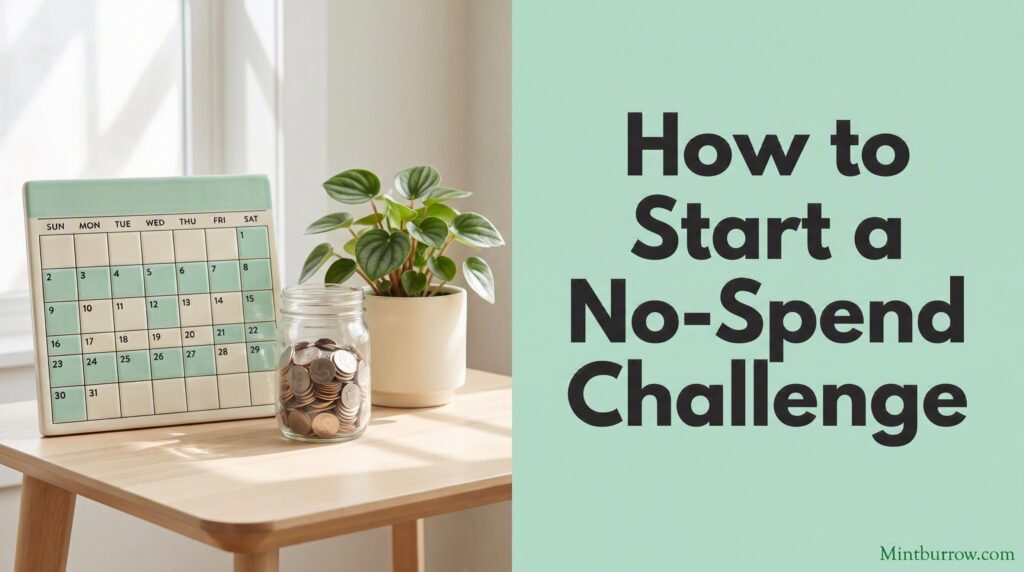
Every January, thousands of people decide to stop spending money. They call it a no-spend month, post about it, and feel great on day one. By the end of the month, nearly 4 in 10 have given up. One survey found that about a quarter of Americans have tried a “No Spend January” — and 39% didn’t finish.
So before we talk about how to do a no-spend challenge, let’s talk about why so many fall apart. Because once you understand that, yours won’t.
What a no-spend challenge actually is
A no-spend challenge is simple. For a set time a few days, a week, or a month you only spend money on the things you truly need. Rent, food, bills, medicine, getting to work. Everything else is off the table. No takeaway, no new clothes, no “treat yourself” buys.
The idea isn’t to punish yourself. It’s to hit pause. When you stop spending on autopilot, two things happen: you save a nice chunk of money fast, and you start to see where your money was quietly slipping away.
It’s a close cousin of budgeting, but not the same thing. A budget is your long-term plan for every month (if you don’t have one yet, start with our guide on how to make a budget that actually sticks). A no-spend challenge is a short, sharp reset a way to shake up your habits and give your savings a quick boost.
Why most people quit (and how you won’t)
Here’s the real reason no-spend challenges fail: people treat them like a task to finish instead of a habit to build.
Think about it. Your spending habits took years to form. You can’t switch them off in one day just because the calendar says so. When someone jumps straight into a strict 30-day challenge with no plan, they white-knuckle it for a week, feel miserable, and give up. Or worse they “finish” the month, feel like they earned a reward, and go on a spending spree that wipes out everything they saved. That last one has a name: revenge spending.
The fix is to think of it as a lifestyle reset, not a one-time task. You’re not trying to survive 30 days and go back to normal. You’re trying to change what “normal” feels like just a little. And you build that slowly.
So start small. Don’t begin with a month. Begin with a long weekend. Three days. Once that feels doable, try a week. Then ten days. Then, if you want, a full month. Each small win builds the habit, and the habit is the whole point. A three-day challenge you finish beats a 30-day one you quit on day four.
First, find out where your money leaks
Most overspending isn’t dramatic. It’s small, quiet, and on autopilot. Before your challenge, it helps to notice where yours goes. A few of the most common leaks:
The daily coffee and the lunch out. A coffee here, a takeaway lunch there on their own they feel like nothing, especially on a busy work day. But they add up fast. Making the same thing at home costs a fraction, and honestly tastes just as good once you get into the habit.
The bored-scrolling buy. This is a big one. You’re not shopping for anything. You’re just bored, so you open a shopping app and scroll. And because it’s in front of you, you end up buying something you didn’t need and won’t remember next week. The buying isn’t the problem the mindless scrolling is.
The one-video subscription. You’re scrolling, you see one good video or show, and you sign up for a whole subscription just to watch it. Then you forget about it, and it quietly charges you every month for something you don’t use. Most people have at least one of these bleeding money right now.
None of these make you bad with money. They make you normal. A no-spend challenge just shines a light on them, so you can decide which ones are actually worth it.
How to set up your challenge
There’s no official rulebook. You write your own rules and writing them down before you start is the step most people skip.
Decide what counts as a “need.” Sit down and split your spending into two lists: allowed and not allowed. This looks a little different for everyone, but here’s a common starting point:
Usually allowed (needs): rent or mortgage, utilities, groceries, transport or fuel, insurance, medicine, and minimum debt payments.
Usually not allowed (wants): takeaway and restaurants, coffee shops, new clothes, gadgets, impulse buys, entertainment, and any subscription you could pause.
Sort out the gray areas now. What about a friend’s birthday? A school trip for your kid? Decide these before they come up, so you’re not making excuses in the moment. Write your rules on your phone or stick them on the fridge.
Pick your length — and keep it short at first. A weekend or a week is perfect for your first try. You can always go longer next time.
Simple ways to actually make it stick
Know your why. “Don’t spend money” is not a goal it’s a rule, and rules are easy to break. A goal is different: “save $300 toward an emergency fund,” or “pay off this credit card.” When you have a real reason, saying no gets a lot easier.
Pause before you buy. When you feel the urge to buy something, stop and ask one question: do I actually need this? A lot of the time, the want came from seeing someone else have it a friend, a stranger online and their need isn’t yours. If you’re not sure, spend on the things you genuinely need first. Once you do, the pull toward the extra thing usually fades on its own.
Remove the temptation. Willpower runs out. Make it easy on yourself: unsubscribe from store marketing emails, delete the shopping apps for now, and remove your saved card details so buying takes effort instead of one tap.
Shop your own home first. Before the challenge, “shop” your kitchen cupboards, freezer, and bathroom. Most of us are sitting on food and supplies we forgot we had. Use those up instead of buying more.
Tell someone, or team up. Doing it with a friend or partner makes it far easier you’ve got someone to keep you honest and cheer you on.
Track it where you can see it. Mark each no-spend day on a calendar or a simple tracker. Watching the streak grow is weirdly motivating, and it’s a small win every single day.
If you slip, don’t quit. Buying one thing you shouldn’t have doesn’t mean you failed. It means you’re human. Pick it back up the next day. One slip isn’t the end quitting is.
What to do instead: fun that doesn’t cost money
A no-spend challenge isn’t about sitting at home bored. It’s about spending your time instead of your money and ideally, on things that actually make your life better. A good rule: swap spending for something that grows you.
- Do something that develops you. Take a free class on YouTube, learn a skill, read, or start something you’ve been putting off. This is spending time on your future self.
- Get outdoors. A hike, a walk, a bike ride, a trip to a park or a lake. Some of the best days out are free, and you come back better for it.
- Lean into your hobbies. Love singing? Sing. Like cooking? Try something new with what’s in the cupboard. The things you already enjoy are usually cheap or free.
- Spend time with people. A long chat with a friend, a game night at home, time with your family — this costs nothing and is usually better than whatever you’d have bought anyway.
- Use the library. Free books, movies, and often free events. It’s one of the most underrated deals around.
Notice the point here: this isn’t “never spend on fun again.” It’s about finding joy that doesn’t need your wallet — and cutting back on the stuff that wasn’t really making you happy anyway.
It looks different for everyone
Like most money advice, a no-spend challenge isn’t one-size-fits-all. Find yourself:
Students. You’re probably already careful. Keep it light a no-spend week, focused on skipping takeaway and impulse buys. Cook with cheap basics and lean on free campus fun.
Shopping for one. Your easiest wins are eating out and bored-scrolling buys. Fill the time with free hobbies and friends so you’re not spending out of boredom.
Families with kids. Make it a game the whole family plays. Do free days out, home movie nights, and park trips. Kids often love the challenge once it feels like a team effort.
On a tight or fixed income. If money’s already tight, you may be doing a version of this every day. Be kind to yourself — a gentle one-week reset to build a small savings buffer is plenty. This isn’t about depriving yourself further.
Higher earners. This is where it gets interesting. When you earn more, a $6 coffee feels like nothing so the leaks are bigger and easier to miss. Your challenge isn’t about need; it’s about noticing. Keep the spending that genuinely adds to your life, and cut the autopilot stuff that doesn’t.
The most important part: what happens after
Here’s where all the effort is won or lost. The challenge ends, you feel proud, and the danger is that you celebrate by spending everything you just saved. That’s revenge spending, and it undoes the whole thing.
So do this the moment your challenge ends: move the money you saved straight into savings. Don’t leave it sitting in your checking account where it’ll quietly disappear. Send it to a savings account, toward your emergency fund, or at your debt. That’s the “pay yourself first” idea, and it’s what turns a fun week into real progress.
And take the one or two habits that felt good maybe the home coffee, maybe cancelling that dead subscription and just keep them. That’s the real prize. Not the money from one week, but a slightly cheaper “normal” that saves you money every month from now on. (Want an easy place to start cutting costs? Our guide on how to save money on groceries pairs perfectly with this.)
Ready to try? Start this weekend
Don’t overthink it. Here’s your simple start:
- Pick a short length — start with three days or a weekend.
- Write your rules — what’s allowed, what’s not.
- Set one clear goal — a real number you’re saving toward.
- Remove temptation — delete shopping apps, plan free things to do.
- When it ends, save the money — and keep the habits that felt good.
A no-spend challenge won’t fix everything overnight, and it’s not meant to. It’s a small reset that shows you what you actually value and what you were just buying out of habit. Start small, be kind to yourself, and let the good habits stick around after the challenge is done. That’s where the real change lives.

Pingback: How to Stop Impulse Buying: 12 Honest Ways That Actually Stick
Pingback: Where Does My Money Go? How to Find the Leaks
Pingback: How to Build an Emergency Fund on a Tight Budget - MintBurrow
Pingback: How to save Money on a Low income (Real Tips)
Pingback: How to Not Overspend on Black Friday (Even When Every Deal Looks Amazing) - MintBurrow