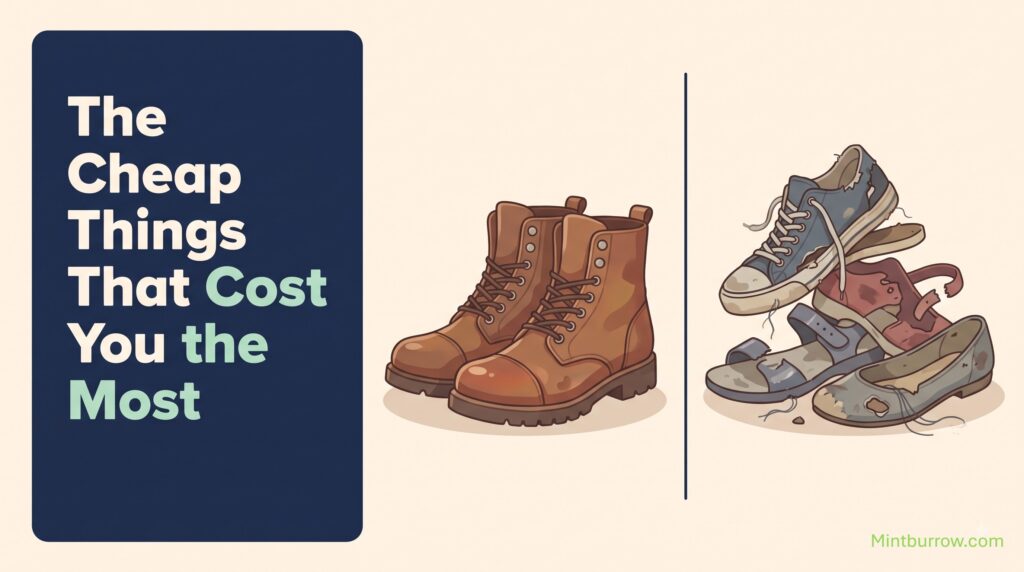
There’s an old idea about a pair of boots that explains almost everything about being broke.
A writer named Terry Pratchett put it best. A good pair of leather boots costs $50 and lasts ten years. A cheap pair costs $10, but the soles give out in a season, so you buy another, and another. Ten years later the person who bought cheap has spent a hundred dollars on boots, more than the person who bought the good ones, and still has wet feet the whole time. Pratchett’s point was sharp: it’s expensive to be poor. The person who could afford the good boots up front pays less in the long run. The person who couldn’t pays more, over and over, for worse.
If you’ve ever felt like you’re working just as hard as everyone else and somehow still falling behind, this is part of why. It’s not that you’re bad with money. It’s that cheap things that cost more are everywhere, and when your budget is tight, you get changed the most.
I want to walk through where cheap really costs you, where it truly doesn’t, and how to tell the difference without needing a big pile of cash you don’t have.
The cheap things that cost more, in three ways
When something cheap turns out to be a mistake, it charges you in three separate ways. Most people only notice the first one.
It costs you in money, again and again. This is the boots problem. I learned it the hard way with a car part. I needed a repair, money was tight, and I went with the cheap replacement part. I figured it wasn’t the original quality, but half as good would still do the job fine. Then the problem came back. And came back again. By the time I was done I’d spent close to double what the good part would have cost me up front. The cheap one didn’t save me anything. It just made me pay in installments, with extra.
It costs you in time, which is really your life. There’s a book called Your Money or Your Life that makes one point I’ve never forgotten: money is just your life energy in another form. Every dollar you spend is a piece of the hours you worked to earn it. So a cheap thing that breaks doesn’t only cost the money to rebuy it. It costs the evening you spend researching a replacement, the trip back to the store, the return, the waiting, the figuring it out again. That’s hours of your one life, spent managing something that should have just worked.
It costs you in daily aggravation. The cheap boots leaked the entire time. That’s the part the price tag never shows: the small, constant misery of using something that doesn’t do its job. The shoes that hurt. The pan where everything sticks. The charger you have to hold at the exact right angle. You paid less, and then you paid again every single day you used it.
But here’s the honest part: expensive isn’t automatically better
This is where most “never buy cheap” articles lie to you. They act like price equals quality, so the answer is always to spend more. That’s not true, and on a tight budget it’s dangerous advice.
Plenty of expensive things are just expensive. Sometimes you’re paying for a name, a logo, or a fancy store, not for anything that lasts longer or works better. I’ve bought cheap things that turned out great. I have a cheap electric trimmer I picked up years ago that still runs perfectly, no trouble, ever. It owes me nothing. Cheap is not the same as junk. Sometimes cheap is just the smart price for a good-enough thing.
And expensive can be its own trap. There’s a book about how wealthy people really live, and one line stuck with me: “big hat, no cattle.” It describes people who spend on looking rich, the flashy stuff everyone can see, while having very little to show for it. Meanwhile the people who are truly secure with money tend to buy good quality and then keep it for years. They’re not chasing cheap, and they’re not chasing expensive either. They’re chasing value. They look at how well a thing is made, not just the number on the tag.
So the goal was never “spend more.” The goal is to stop overpaying, whether that’s overpaying once for a logo or overpaying ten times for something that keeps breaking.
The one question that beats both traps: cost per use
Here’s the trick that cuts through all of it. Don’t ask “how much does this cost?” Ask “how much does this cost every time I use it?”
Take the price and divide it by how many times you’ll realistically use it. That’s the real price.
A $50 pair of boots you wear all winter for a few years comes out to pennies each time you put them on. Three $15 pairs over those same years cost you more, and your feet were cold in between. The cheap pair looked cheaper. It wasn’t.
But run the same math the other way. A $200 fancy ice cream maker you’ll use three times a year is expensive every single time you touch it. A $30 one does the job for a fraction of the cost per use. Here the cheap one wins, easily.
That’s the whole test. Two honest questions:
- How often will I really use this? (Be honest. We all overestimate.)
- How long should it last, and can it be repaired?
A thing you’ll use constantly, that should last years, is worth spending up on. Something you’ll use rarely, or that’s a passing trend, is exactly where cheap belongs.
Where it’s worth spending up
These are the things that tend to punish you for going cheap, because you use them hard and often:
Shoes and boots you wear all the time. A mattress you sleep on every night for years. Anything you cook with daily, like a decent knife or a pan that doesn’t ruin the food. Tires, the only thing between your car and the road. A reliable washing machine, if the alternative is years of quarters at the laundromat. Tools you actually use often, not once.
Notice the pattern: high use, long life, and a real difference in the daily experience. That’s the “spend up” zone.
Where cheap is completely fine
And here’s the freeing part, the half those other articles skip. A huge amount of stuff is totally fine to buy cheap:
Store-brand pantry staples. Flour is flour. Generic medicines, which by law have to contain the same active ingredient as the name brand and can cost 80% less. Trendy clothes you’ll wear a handful of times. A tool you need for one weekend project. Most phone cases, most cables, most basic kitchen odds and ends. Anything you’ll use rarely, or won’t own for long.
Buying the store brand on these isn’t being cheap. It’s being smart. You’re saving your money for the few things that actually deserve it.
The part nobody says out loud: being broke is expensive
Now the hard truth underneath all of this, and it’s not your fault.
When you don’t have much money, you get charged more for the exact same life. It’s real, and it has a name: the poverty premium.
Can’t afford the big bag? You buy the small one, which costs more per ounce. Can’t pay cash for a fridge? The rent-to-own place will happily hand you one, and by the time you’ve finished the weekly payments you’ve paid two or three times what it costs in a store. No savings buffer when the car dies? You take the loan with the brutal interest rate, because you have no other option, and poor-credit borrowers pay roughly three times the interest that good-credit borrowers do. No bank account? You pay a fee just to cash your own paycheck.
None of that is because you’re careless with money. It’s because being short on cash forces you into the expensive version of everything. The system charges a fee for being poor, and it collects it every single day.
You can’t fix all of that on your own. But you can chip away at the piece you control.
How to escape the cheap trap on a real budget
Buy quality secondhand. This is the big one. The boots trap assumes you have to choose between a cheap new thing and an expensive new thing. There’s a third door: a well-made thing, used. Thrift stores, refurbished electronics, secondhand furniture, marketplace listings. You get the durability of the good version at the price of the cheap one. This is how you beat the trap without the cash the trap assumes you don’t have.
Buy the best you can afford, then take care of it. You don’t have to buy the best there is. Just the best you can manage right now, and then make it last. Resole the boots. Sharpen the knife. Replace the phone battery instead of the whole phone. A maintained good-enough thing beats a neglected expensive one.
Build a small buffer so you’re not forced into the cheap version. This is the quiet fix for the poverty premium. The reason you get charged more is that being out of cash removes your choices. Even a small cushion gives some of them back. I keep whatever’s left after my expenses and savings each month, and it just builds up quietly until I can buy the thing properly instead of grabbing the desperate option. And here’s a bonus I’ve noticed: by the time the money’s there, half the things I thought I urgently needed, I don’t need anymore. The waiting sorted the real needs from the passing wants, for free.
The takeaway
Cheap isn’t the enemy, and expensive isn’t the hero. Both can rob you.
The real skill is seeing the whole price of a thing, not just the sticker: the money to rebuy it, the hours to deal with it, the daily aggravation of using it. Spend up on the few things you’ll lean on hard for years. Go cheap, happily, on everything you won’t. And when money’s too tight to buy the good version, buy it used, keep it alive, and build even a tiny buffer so you’re not forced to pay the poor tax forever.
You’re not bad with money. You’ve just been charged the cheap tax, like everyone who’s ever been broke. Now you can see it coming.
If a small monthly cushion is the piece you want to start with, sinking funds are the simplest way to build one. If it’s the pull to grab the cheap thing right now that gets you, here’s how to stop impulse buying. And if you’re trying to stretch a low income as far as it goes, saving money on a low income goes deeper on this.