Two ways to spend forty dollars
Pay with your phone and the whole thing takes two seconds. Tap, small beep, walk out. You never see a number. You don’t check your balance, because who checks their balance standing at a counter with three people behind them? The money left. Nothing about the moment told you so.
Now pay with cash.
You have to open your wallet, and here’s the thing about opening your wallet: you can see what’s in it. Every single time. Two twenties come out and what’s left is sitting right there in your hand, and you feel something about it. Usually not a good something.
That gap between the two is the whole argument for the cash envelope system, which you’ve probably seen online under its newer name: cash stuffing. Videos of people counting bills into labelled binder pockets have pulled in billions of views, mostly from women in their twenties and thirties, and somewhere along the way it turned into an aesthetic as much as a budgeting method.
So does it work, or does it just film well?
I went looking at what the research says, what it doesn’t say, and what I’d tell a friend who asked. Short version: it works, for a narrower job than the videos suggest.
What cash stuffing is
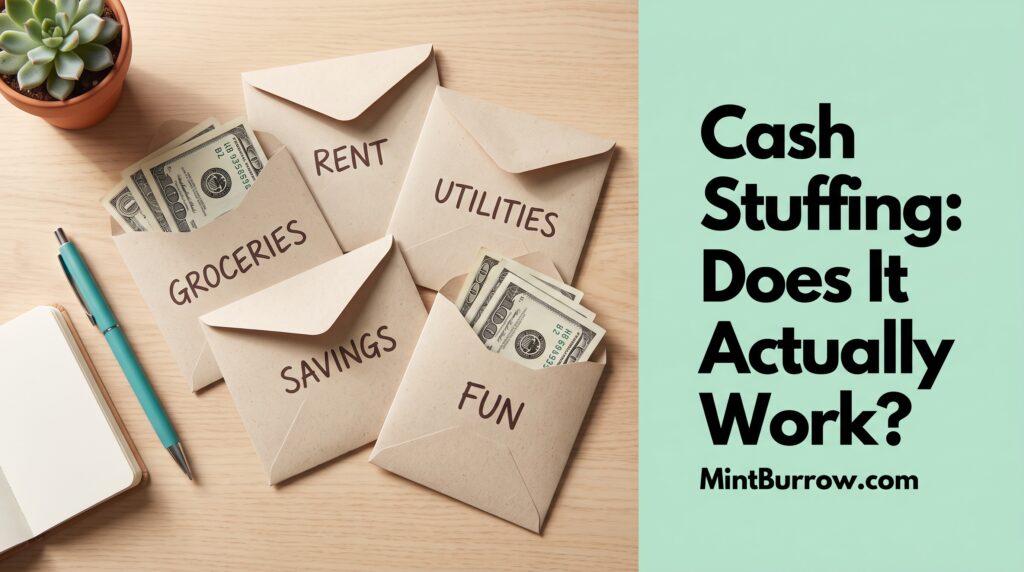
You take your spending money out as cash, split it into labelled envelopes by category (groceries, gas, eating out), and that’s your budget. When an envelope is empty, you’re done with that category until next payday.
That’s the whole method. Older folks called it the envelope system. Your grandmother might have called it the jar system and kept it in a kitchen cabinet. The name changed when it hit TikTok; nothing else did.
One thing before we go further. This is a tool for spending, not a budget. You still have to know what you earn and what your bills cost before you can decide what belongs in an envelope. If that part isn’t solid yet, start with [How to Make a Budget That Actually Sticks] and come back.
Does it work? The honest answer
There’s real research here, and it mostly says yes. With a catch.
The case for it
The famous study is from MIT, back in 2001. Researchers ran an auction for sold-out Celtics tickets. Half the bidders were told they’d pay by credit card, half by cash. The card group bid dramatically more for the same seats, in some cases close to double. Same tickets, same kind of people, different payment method.
Economists call this the pain of paying. It’s the reason your wallet feels different from your phone.
The second study convinces me more, because it involved people on genuinely tight budgets rather than students bidding on basketball. Researchers gave day labourers their savings either in one envelope or split across two labelled ones. The two-envelope group saved substantially more, by one account around 70 percent more. Putting a photo of the person’s children on the envelope pushed it higher still.
Nothing about the money changed. Only the packaging did. Opening a labelled envelope felt like breaking a small promise, and that feeling turned out to be worth real money.
Richard Thaler won a Nobel Prize partly for explaining why this happens. He calls it mental accounting: our brains refuse to treat all money as the same money. Envelopes take an instinct you already have and make it physical enough to argue with.
The part the videos leave out
In 2024 a group of researchers pooled 71 studies on whether people spend more with cards than with cash. They found the effect is real. They also found it’s small, and that it has been shrinking as everyone got used to paying by card.
Which makes sense. That MIT study is from 2001, when pulling out a credit card still felt like something. In a world where you buy coffee with your watch, the shock has worn off.
So the honest version isn’t “cash makes you spend less, science says so.” It’s this: cash adds friction at the exact moment you’d otherwise overspend. That friction helps some people a lot. It helps less than the internet claims.
The condition nobody mentions
Here’s something I believe about this system that I’ve never seen written down anywhere.
Cash envelopes work well when your spending is fairly predictable. They fall apart when it isn’t.
Think about what you’re doing when you stuff an envelope. On payday, you’re deciding exactly how much a category will cost you over the next two weeks. If groceries usually run about $180 and gas about $60, that’s an easy call and the envelope will be roughly right. The system feels brilliant, because your guess was good.
Now try the same thing in a month where a kid outgrows their shoes, your sister gets married, and prices at the store jump. Your envelope amounts were guesses. They were wrong. And the method that was supposed to help is now just telling you no.
I wrote about the other half of this in [Sinking Funds]: the bills that wreck budgets are the ones where you know the date but not the amount. This is the same problem, pointed at your daily spending instead of your annual bills. Envelopes handle steady costs beautifully and lumpy ones badly. That’s exactly why sinking funds sit alongside them rather than instead of them.
Rule of thumb: if you can predict a category within about 10 percent, it makes a good envelope. If you can’t, it needs a sinking fund or a buffer instead.
How to set it up
Pick the right categories
Only variable, in-person spending belongs in an envelope. Groceries, eating out, gas, fun money, clothing, personal care, household bits.
Dave Ramsey, whose whole system leans on this tactic, suggests keeping it to five or eight categories on the grounds that any more and people quit. I’d go further and say start with fewer. More on that at the end.
Leave the rest digital
This is where beginners come unstuck. Some things should never be cash:
- Rent or mortgage, utilities, insurance, car payment, phone. Autopay, all of it.
- Every subscription you have. If you’re not sure what those are, [How to Cut Your Monthly Bills] will help you find them.
- Anything bought online.
- Gas pumps that pre-authorise your card, which plenty now do.
A cash system that pretends the digital half of your life doesn’t exist isn’t a system. It’s a hole with envelopes around it.
Set amounts from real numbers
Pull up two or three months of statements and look at what you spent, not what you wish you’d spent. If groceries have been running $500, don’t stuff $300 in there and call it discipline. You’ll blow through it by week three and quit, and you’ll blame yourself instead of the number. Not sure where the money’s been going? [Where Does All My Money Go] covers finding out.
Refill on payday, not on the 1st
Smaller and more often beats one big withdrawal. Groceries at $500 a month and you’re paid twice? Take out $250 each time. Less cash sitting in the house, and the envelope only has to stretch a shorter distance.
When it’s empty, stop
This is the system. The whole thing. Empty envelope means done, no card, no quietly borrowing from the gas envelope to cover dinner.
That single rule is doing all the work. Without it you’ve made a craft project.
James Clear, who wrote Atomic Habits, would call that empty envelope friction. You’ve made the thing you’re trying to stop doing physically harder to do. Not willpower. Just a better setup.
Where it goes wrong
No method deserves a free pass, and this one carries some real costs that the videos skip past.
Start with the obvious one: cash that gets lost or stolen is gone. No fraud protection, no chargeback, nobody to call. That’s worth thinking about before you leave four hundred dollars in a binder on a shelf.
Then there’s what cash doesn’t do for you. It builds no credit history, which matters more than people realise when you go to rent an apartment or finance a car. It earns no interest, while the same money in a decent savings account would earn something and stay insured. It earns no rewards. Live entirely in cash for years and you’ll pay for it quietly, in ways that never show up as a line item.
Practicality is the other issue. Some businesses have gone card-only. Most shopping happens online. Card readers do not care that you brought exact change. Cash isn’t dead, and the Federal Reserve’s 2026 payment survey found Americans still reach for it on about one payment in seven, with three quarters of people carrying at least some. But it sits third behind credit and debit now, and the world is built around the other two. It does still work when the network goes down, which is a point in its favour on the day it matters.
Smaller frictions add up too. Bank or ATM trips every payday, possible fees, the counting. None of it is much on its own. It’s not nothing when you’re already tired.
And if your income changes week to week, the whole thing gets harder, because now you’re guessing on top of guessing.
If carrying cash isn’t realistic
You can keep most of the structure without the bills.
- Goodbudget is the closest digital copy of paper envelopes. The free version limits how many you get, which is plenty to start with.
- Bank buckets. Several online banks let you split one savings account into named pots. Your money stays insured and earns interest, which paper cash cannot do.
- A separate debit card for one category. Load the grocery budget onto it and use nothing else. A swipeable envelope.
- EveryDollar or YNAB. Full budgeting apps built on the same give-every-dollar-a-job idea. YNAB is excellent and runs over a hundred dollars a year, which is worth knowing before you sign up.
Does the digital version work as well? Partly. The labelling and separating survives, and that’s the Thaler part, so it still helps. What you lose is the wallet moment, the physical sight of your money getting thinner. If tapping your phone is your specific problem, a digital envelope may be treating everything except the disease.
The argument against all of this
Worth hearing the other side, because it’s a good one.
Ramit Sethi would tell you to skip envelopes entirely. Automate your bills and savings, spend what’s left without agonising, and stop spending your evenings managing money in little compartments. His whole position is that a good system needs no willpower and no maintenance, and cash stuffing is maintenance.
He’s not wrong. But notice that both approaches are fighting the same enemy, which is the moment where you decide with your own two hands. He removes the decision by automating it. Cash stuffing makes the decision harder to get wrong. Different tools, one problem. If [impulse buying] is where you struggle, friction at the till will probably do more for you than a spreadsheet.
What I’d tell you to do
If a friend asked me whether to try this, my answer would depend entirely on how much their own spending gets away from them.
Some people can look at a balance and simply not spend it. If that’s you, skip the envelopes. You’re already doing the thing envelopes exist to force. Automate everything and go live your life.
If it isn’t you, and the money keeps vanishing without a clear story of where, then dividing it up, writing a name on it, and putting it somewhere you physically have to open is a useful crutch. There’s no shame in a crutch. That’s what they’re for.
Either way, don’t do what the videos do. Here’s the version I’d suggest:
- Automate the boring half. Every fixed bill, every savings transfer. Don’t touch these.
- Cash-stuff one category. One. Whichever one you overspend. For most people that’s groceries or eating out.
- Run it for a month. Came in under? Add a second envelope. Were you raiding it by week two? The amount was wrong, not you.
- Keep a small buffer envelope so one surprise doesn’t collapse the whole thing.
- Treat it as training. The goal isn’t carrying envelopes forever. It’s learning what your spending really costs, and then not needing them.
One month, one envelope. Small enough that failing costs you nothing, and if it works you’ll know inside two weeks.
Want a companion experiment while you try it? [A no-spend challenge] pairs well, because it shows you fast which spending you don’t miss. And if the real problem is making it to payday at all, start with [How to Stop Living Paycheck to Paycheck] instead. Envelopes won’t fix a timing problem.
The free Budget Planner has a page for working out your category amounts before you take any cash out, which is the step most people skip: