Most “emergencies” aren’t emergencies
Think about the last expense that wrecked your month.
Car registration. The insurance renewal. Christmas. New tires. The dentist. Back-to-school supplies that somehow came to $200.
Now be honest: did any of those actually surprise you? Registration is due the same month every year. Christmas has never once moved. Your insurance renews on a schedule the company mailed you months ago.
None of that is an emergency. It only felt like one because nothing was set aside for it. And that’s a completely different problem with a completely different fix.
The fix has an unfortunately boring name: a sinking fund. It is the least exciting idea in personal finance and probably the one that would change your months the fastest. If you’ve read [how to stop living paycheck to paycheck], this is the deep dive on the step most people skip.
What a sinking fund actually is
A sinking fund is money you save up on purpose, a little at a time, for a bill you already know is coming.
That’s the entire idea. Instead of getting hit with $600 for car insurance in March, you move $100 a month into a pot starting in October. March arrives, the bill arrives, the money is already there. Nothing dramatic happens which is the point.
The math is one line:
Total cost ÷ months until it’s due = what you set aside each month
$800 for the holidays, starting in January? About $67 a month. $600 for tires in six months? $100 a month. That’s it. No app required.
None of this is new, either. A little book from 1926 called The Richest Man in Babylon built its whole argument on setting money aside before it can wander off to other things the origin of the phrase “pay yourself first.” A sinking fund is just that idea pointed at a specific bill.
And about that name — it has nothing to do with your money sinking. The term comes from 18th-century government finance, when Britain set up a “sinking fund” to steadily sink, or pay down, the national debt. Alexander Hamilton brought the idea to the US in 1790. Three hundred years later it got handed to the rest of us with the worst possible branding.
Sinking fund vs emergency fund (the part everyone mixes up)
These two get confused constantly, and confusing them is expensive because people raid the emergency fund for Christmas, then have nothing left when the furnace dies in February.
One line separates them: a sinking fund is for the known. An emergency fund is for the unknown.
| Sinking fund | Emergency fund | |
| For | Planned, expected, irregular | Unplanned, urgent, unwanted |
| Examples | Christmas, registration, tires, vacation, back-to-school | Job loss, ER visit, furnace dies |
| Do you know it’s coming? | Yes | No |
| How much | The cost of that one thing | 3–6 months of essentials (start at $500) |
| The feeling | “This is coming — let me spread it out” | “I hope I never touch this” |
If you don’t have an emergency fund yet, start there first [How to Build an Emergency Fund on a Tight Budget] walks through it, and the [emergency fund calculator] gives you a first target based on your actual bills. A true emergency is the thing most likely to put you on a credit card. Get a small cushion going, then add sinking funds alongside it.
Dave Ramsey who did more than anyone to get ordinary households using the phrase “sinking fund” has a name for the emergency fund: Murphy repellent. Murphy being that guy where anything that can go wrong, does. With nothing set aside, he reckons you’re basically leaving the porch light on for him.
Ramsey is also stricter than I am about the order. His version says get $1,000 saved, kill the debt, and worry about most sinking funds later. He has a point, and I’d split the difference like this: the funds that prevent emergencies car repairs, the insurance renewal can start early, even at $10, because they stop small problems from becoming credit card problems. The lifestyle ones vacation, the nicer Christmas those can wait until the cushion exists. Nobody credible tells you to fund a holiday before you can handle a flat tire.
The part nobody tells you: knowing the date isn’t the hard part
Here’s something I figured out from my own budget, and I’ve never seen it written down anywhere.
Some bills don’t rattle you at all. My car payment and my insurance premium have never once caused a bad month not because I’m disciplined, but because I know two things about them: the exact date, and the exact amount. When both numbers are locked, planning is trivial. I pay those first and stop thinking about them.
The expenses that knock a month sideways are the ones where you know the date but not the amount.
Christmas is December 25th every year but is it a $600 Christmas or a $1,100 Christmas? Depends on prices, on who’s hosting, on how many people you’re buying for this year. Back-to-school is August but the supply list changes and so do the prices. A dental visit is scheduled until the x-ray finds something. Car maintenance is due but is it an oil change or is it the transmission?
That’s the real enemy: known date, unknown amount. And it changes how you should save for these things.
For fixed bills, save the exact number. For the variable ones, save your best estimate and then add a cushion round $67 up to $75, round $100 up to $120. If the year is kind, you end up with money left over and a head start on next year. If prices jump, you’re covered instead of reaching for a card. The extra $8 a month is the cheapest insurance you will ever buy.
Morgan Housel has a phrase for that cushion that I think about a lot: room for error. His argument is that the most important part of any plan is planning for the plan not to go to plan. You know the car will need something this year. You don’t know what, and you don’t know how much. Room for error is the money that covers the “how much.”
Why this hits harder when money is tight
There’s a book called Scarcity, by two researchers who study what being short of money does to people, and one of their experiments has stuck with me since I read it.
They stopped shoppers at a mall and asked them to imagine a car repair, then gave them a puzzle test. When the imaginary repair cost $300, everyone scored about the same regardless of income. When it cost $3,000, the lower-income shoppers’ scores dropped by roughly the equivalent of 13 IQ points a decline the researchers compared to losing a full night’s sleep.
Nobody had actually paid anything. Just thinking about a bill they couldn’t cover was enough to eat their concentration.
That’s the real cost of having no cushion, and it’s why I get irritated when people call this a discipline problem. Money stress makes planning harder at exactly the moment planning matters most. A sinking fund isn’t only cash sitting in an account it’s the thing that keeps a $700 repair from taking over your head for three weeks.
What to actually save for (the list)
Don’t start all of these. This is a menu, not a to-do list pick two or three. The ones marked with a star are the ones that quietly wreck the most budgets.
Car and getting around
- ★ Repairs and maintenance — AAA’s 2025 Your Driving Costs study puts maintenance, repairs and tires at about 11 cents a mile. Drive a typical 15,000 miles a year and that’s roughly $1,650, or about $135 a month. Most people budget $0 for it and call the result bad luck.
- ★ Registration, tags, and inspection
- ★ Insurance premium — if you pay it every six months or annually. The national average for full coverage was about $2,144 a year in 2025 (Insurify, February 2026).
Home
- Repairs and maintenance the water heater has a lifespan, and it is shorter than you think
- Appliance replacement
- ★ Property taxes, if they’re not rolled into your mortgage payment
The calendar ones
- ★ Christmas and gifts — Americans planned to spend an average of $890 per person on the 2025 holidays (National Retail Federation, October 2025). This is the single most predictable expense of the year and the one most likely to end up on a credit card.
- ★ Back-to-school — K-12 families planned about $858 in 2025 (NRF, July 2025).
- Birthdays, weddings, graduations an entire season for some families
- ★ Annual subscriptions the yearly renewals hiding in your accounts. [How to Cut Your Monthly Bills] covers how to hunt them down.
Health and family
- Medical and dental copays, deductibles, glasses, braces
- ★ Pet care — an emergency vet visit averages roughly $653 for dogs and $919 for cats (Pumpkin claims data, 2025), and most pet owners have nothing set aside for it.
- Kids’ activities, sports, camps
The rest of life
- Vacation and travel including the trip home for the holidays
- ★ Phone and tech replacement your phone will die, and it will not be convenient
- Clothing, especially growing kids
One thing that is not a sinking fund: rent and monthly utilities. Those live in your regular budget see [How to Make a Budget That Actually Sticks] if that part isn’t solid yet.
And your list should look nothing like mine. Everybody knows where their own money bleeds. If someone in your family has an ongoing health condition, medical gets funded harder. If you drive a 12-year-old car, repairs come first. If your family does Christmas big, be honest about that instead of pretending this year will be different. The right categories are the ones you already worry about.
How to start when there’s barely anything left
Here’s where most articles lose people. They hand you fifteen categories at $50 each and you close the tab, because that’s $750 a month you do not have.
So do this instead.
Pick one. The nearest and scariest whichever expense is coming soonest and most likely to force you onto a credit card. For most people that’s car repairs or the insurance renewal.
Start at $10–$25 a month. Yes, that’s small. No, it will not cover a transmission. It does three things anyway: it starts the habit, it makes the category real in your head, and in twelve months it’s $300 you didn’t have. Half the ideal amount still beats zero.
James Clear, who wrote Atomic Habits, would tell you the $10 was never about the $10. His rule is to make a new habit small enough that you can’t talk yourself out of it, because showing up is the part people fail at not the amount. The number grows later, once the transfer is just something that happens.
Add the second one only when the first is running smoothly. Three to five funds is plenty. Split $20 across fifteen categories and none of them will ever be big enough to matter.
Use windfalls to jump-start. A tax refund is the single best sinking-fund starter there is it lands once a year and disappears fast otherwise.
If you genuinely have nothing left over after essentials, this article isn’t your first step How to Save Money on a Low Income and Where Does All My Money Go are. Find the money first, then give it a job.
Where to keep it (and why it disappears)
This part matters more than people expect, because setting money aside and actually keeping it aside are two different skills.
The options
- A separate savings account with named buckets — best for most people. Several online banks let you split one account into named pots (Ally allows up to 30, SoFi up to 20), so one account holds “Car,” “Christmas,” and “Vet” without you doing any math. It earns interest and it’s not sitting next to your grocery money.
- One savings account plus a simple list — same effect, done manually. A notebook or a spreadsheet with each fund, its target, and its balance. Free, and it works.
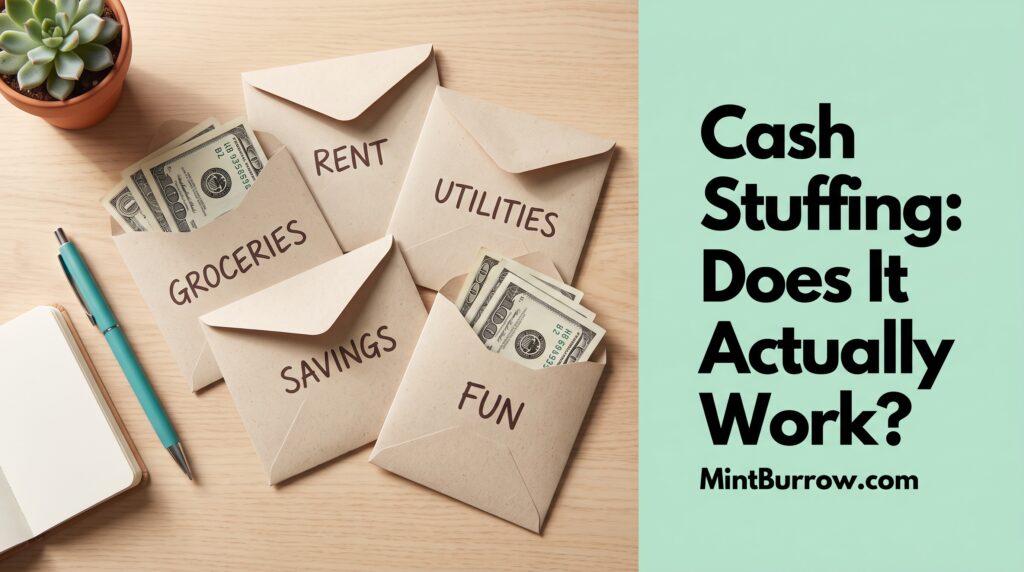
- Cash envelopes — physical and hard to ignore. No interest, and there’s a real risk in keeping large amounts at home, but for smaller funds it’s effective precisely because spending it feels like something.
- A budgeting app — YNAB does this beautifully and costs around $109 a year. If you’re reading an article about scraping together $25 a month, a free spreadsheet does the same job.
Why the money vanishes anyway
I’ve watched this happen to people who did everything right, and it comes down to three things.
1. It’s too easy to reach. If your savings has a debit card attached and shows up next to your checking balance in the same app, it isn’t really separate it’s just checking with extra steps. Put a little friction in the way. My own fixed-bill money sits in a different account entirely, and the small inconvenience of moving it back is exactly what keeps it there. Erin Lowry, who wrote Broke Millennial, pushes this further: keep the account at a different bank so you don’t even see it when you check your balance, and give it a real name. Not “Savings.” Something like “Tires, March.” People skim from savings. They don’t skim from tires.
There’s decent research behind that, by the way. In one study, workers given their savings in labelled envelopes saved substantially more than those handed the same money in one unlabelled envelope and the ones whose envelope had a photo of their children on it saved more still. Breaking into a pot with a name on it feels like breaking a promise. Nothing about the money changed. Only the label did.
2. A real emergency takes it. This one isn’t a failure. That’s money doing its job but it’s also why the emergency fund needs to exist separately, so a bad week doesn’t empty the Christmas money.
3. The lifestyle refuses to hold still. This is the real one. You can hand someone the math, the spreadsheet, every logical argument and if they don’t actually want to leave that money alone, none of it works. No system survives a person who has already decided to spend. That isn’t a lecture; it’s just worth knowing that the tool isn’t the hard part.
What it looks like when it works (and when it half-works)
A few years back my family had a surgery we knew was coming. Not a surprise scheduled months out. I did what you’re supposed to do and put money aside for it every month.
It wasn’t enough. Medical costs are the definition of known date, unknown amount, and the final number came in well above the estimate. We had school costs that same stretch and home repairs already underway. So I ended up pulling from other places to close the gap, which is not the tidy ending a personal finance article usually gives you.
But here’s the part I think about. Every fixed bill that season the insurance, the car payment, the utilities went through without a single late payment or a single call to anyone. In the worst financial month of that year, the boring stuff simply happened, because the boring stuff had been funded months earlier.
That’s what these funds actually buy. Not a perfect month. A floor under a bad one.
Five ways people get this wrong
- Starting fifteen funds at once. Overwhelm, then abandonment. Three to five.
- Keeping it with spending money. If it’s in checking, it’s gone by the 20th.
- Treating it as the emergency fund. Two different jobs, two different pots.
- Not automating it. Set the transfer for the day after payday. Ramit Sethi says he doesn’t even try to save money trying runs on willpower, and willpower runs out around the third bad week. So he automates the transfer and lets the money leave before he can have an opinion about it. That’s not discipline, that’s just good plumbing.
- Setting an amount you can’t hold. $120 a month you abandon in March is worse than $30 a month you keep all year. Stretch the timeline instead of quitting.
Start with one
Not a system. Not a spreadsheet with fourteen tabs. One fund, for the one expense you already know is going to hurt.
Work out the cost, divide by the months you’ve got, round it up a little, and move that amount somewhere slightly annoying to reach. Then forget about it until the bill shows up and you find out it’s already handled.
The first time that happens, you’ll understand why people who do this get so boring about money. Nothing goes wrong, and it stops being a story.
If you want the whole thing laid out categories, amounts, a place to track each fund the free Budget Planner has a page for exactly this: